
In this guide
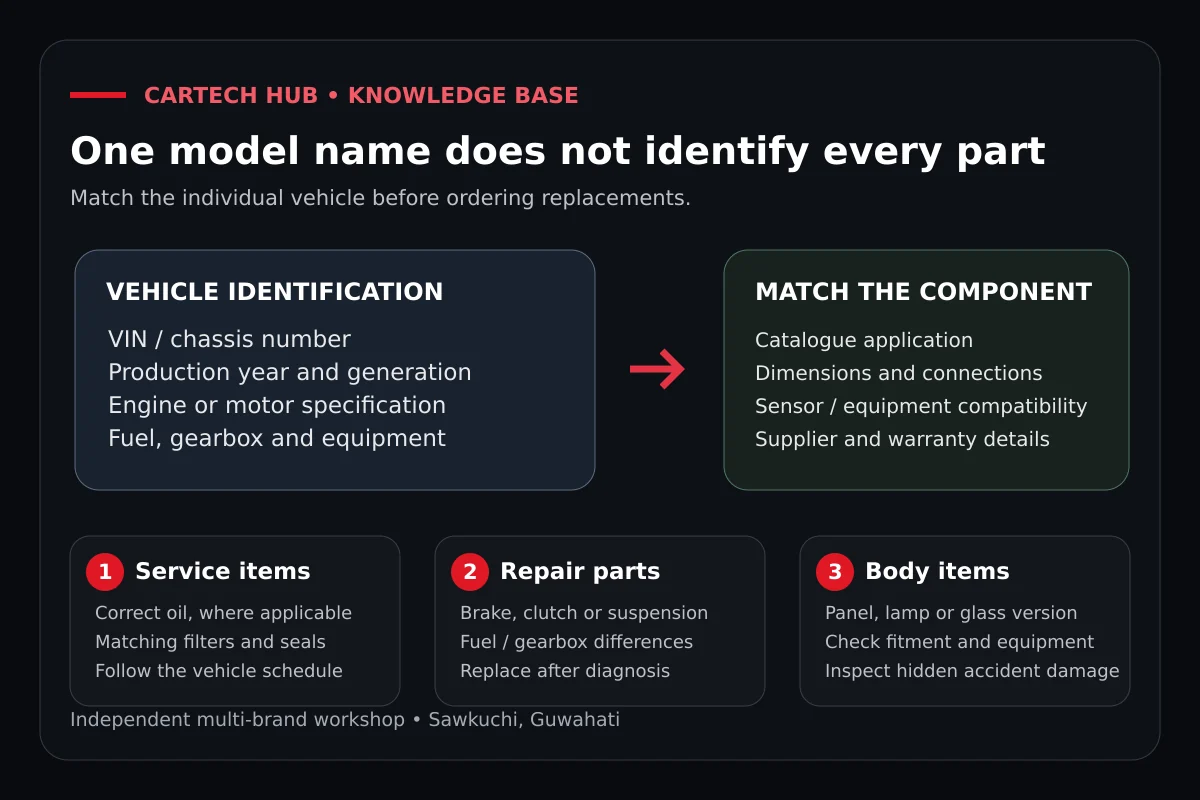
The name Sierra can describe very different Tata vehicles. A current Tata Sierra EV parts request should never be handled as a parts request for an older combustion-engine Sierra. At CarTech Hub in Guwahati, the registration, vehicle identification number, year and actual equipment establish which vehicle is being discussed before a service or accident estimate begins.
Primary manufacturer information now lists Sierra EV as an electric product. This guide avoids speculative launch dates, battery figures and unverified fault claims. It focuses on a practical challenge for owners: arranging appropriate maintenance and a body or glazing repair without confusing the electric vehicle's requirements with an older model's parts catalogue.
Begin with a vehicle-specific maintenance file
Obtain the Sierra EV manual and schedule for the exact vehicle. Record previous inspections, kilometre readings, elapsed time and any unresolved advice. An early ownership period does not justify inventing common failures or replacing parts pre-emptively. A concern should be supported by the symptom, inspection or applicable scheduled requirement.
Tell CarTech Hub how the car is used in and around Guwahati, including road-edge impacts, travel beyond Assam, storage or water exposure. Photograph dashboard warnings when it is safe to do so. Do not repeatedly energise an EV with a serious warning merely to reproduce it for the workshop. Appropriate manufacturer or qualified EV support may be the first step rather than a general repair booking.
Chassis and braking remain part of electric-car care
Tyres, wheels, brake condition, suspension and steering need the specified inspections. Match friction pads, discs or other relevant brake assemblies to the fitted system; regeneration does not cancel brake-fluid or hydraulic checks. ABS sensing and wiring should be diagnosed when warning information or inspection makes them relevant.
Assess the actual suspension arms, bushes, links, joints, bearings and damping components rather than use an older Sierra checklist. A pull after hitting a road edge can require tyre, wheel and suspension damage checks before alignment. For a long journey out of Guwahati, allow time for diagnosis and correct parts sourcing rather than book unresolved safety concerns on the departure morning.
Make the EV architecture part of the scope discussion
Manufacturer information describes different Sierra EV drive configurations, including QWD equipment on relevant versions. Do not assume the number or arrangement of motors from the model name alone. Traction motors, reduction drives, charging equipment and power electronics require configuration-specific information and qualified investigation.
Routine engine oil, combustion-engine filters, ignition plugs, fuel injectors and a conventional manual-clutch replacement are not the Sierra EV service list. Its auxiliary 12-volt battery supports low-voltage functions and must not be confused with the traction battery. Lighting, wipers, switches and relevant low-voltage equipment can be discussed within the workshop's confirmed capability.
Separate cabin ventilation from high-voltage AC work
Inspect airflow, the relevant cabin filter, blower operation and controls when comfort changes. Cooling diagnosis can involve the condenser, applicable fans, sensors and the EV thermal-management system. Electric-compressor or high-voltage work requires trained personnel with the appropriate process. A part described generically as a radiator or cooling component still needs its correct EV function and specification established before ordering.
CarTech Hub does not claim unverified internal battery, traction-motor overhaul or high-voltage repair facilities in this article. Some tasks may need manufacturer-supported diagnosis, an authorised channel or a qualified EV specialist. Define that referral and responsibility before agreeing to the repair, rather than discovering the limitation after dismantling.
Treat glazing and nearby body damage as one inspection question
A broken windshield or side-glass complaint should identify the actual glazing, mounts, seals, fitted sensors and nearby body condition. The correct glass and installation process can depend on equipment. Distorted pillars, doors or panel openings require assessment before a replacement pane is installed. Camera or other system calibration may be needed where fitted and affected; it is not assumed universal.
Body-part requests can involve bumper covers and brackets, bonnet, fenders, doors, quarter panels, tailgate, lamps, mirrors and trim. Check part numbers and functions against the EV variant. Do not use classic Sierra body pieces or assume another current Tata SUV panel is a direct substitute. A denting and painting estimate should explain repairability, replacement, preparation and blending, with the availability of the proposed components confirmed.
An underbody strike, damaged battery enclosure or exposed high-voltage cable calls for trained assessment before use or charging. Keep away from electrical damage and follow appropriate recovery advice. Opening, isolating or attempting to dry a battery assembly is not safe owner maintenance.
Prepare an insurance enquiry without presuming coverage
CarTech Hub can assist Sierra EV customers in Guwahati with accident inspection coordination, repair estimation and claim-document preparation. First notify the insurer and obtain its instructions. Prepare the policy details, RC, driving licence, event photographs and required claim form. Submit police or other reports when required for the incident. Explain whether the glazing damage arose from an accident or another event so the insurer can evaluate the actual cause.
The insurer or surveyor may inspect before glass removal, panel dismantling or replacement approval. Retain evidence as instructed. Itemise glass, body components, fitting labour, paint work, calibration and any qualified EV assessment. If additional damage becomes visible, request a supplementary review rather than expand the work on the strength of a preliminary estimate.
For customers with HDFC ERGO or Generali Central cover, claim requirements should be taken from the actual policy and insurer channel. These examples do not confirm cashless affiliation. A third-party-only policy does not pay to repair the owner's Sierra EV. Warranty questions, gradual wear and accidental damage also need separate evaluation.
Confirm settlement, consent and the final handover
Cashless availability at CarTech Hub depends on policy conditions, claim admissibility, survey findings, insurer authorisation and applicable network or workshop eligibility. Obtain the customer's consent to the planned operations separately from the insurer's payment approval. Qualified EV or glass/calibration work must be assigned only to a party whose capability is confirmed.
Ask which deductibles, depreciation where applicable, consumables or other non-payable amounts remain. An EV or zero-depreciation add-on is not an unconditional settlement promise. Final documents and the itemised invoice support the appropriate claim route. Delivery should explain completed work, the customer balance, specialist records and any issue requiring follow-up.
Arrange a Sierra EV discussion with useful supporting details
Use the Tata article directory, accident repair guide and electrical service page. Read the Generali Central information, or compare the Harrier EV guide for a wheel-impact scenario.
Book online, request insurance assistance, call +91 98647 70033 or WhatsApp CarTech Hub. Open Google Reviews when considering your visit. Our Guwahati business is an independent multi-brand workshop and does not claim Tata-authorised status; confirm scope and availability first.
Quick answers
Can the original Tata Sierra parts catalogue be used for Sierra EV?
No. The current electric vehicle needs its own VIN, variant and equipment-based identification. Sharing the Sierra name does not make body, chassis or propulsion components interchangeable.
Are all Sierra EV versions equipped with QWD?
Do not infer that from the model name. Confirm the actual manufacturer-listed variant and drive configuration before making any drivetrain parts or diagnostic decision.
Can Sierra EV glass replacement require calibration or body checks?
Yes, when the fitted equipment or surrounding damage makes it necessary. The relevant glass, mounting condition and manufacturer procedure determine the requirement; it is not assumed for every pane.
Will an EV-related add-on automatically cover every damaged component?
No. The insurer assesses the event against the specific policy, exclusions and add-on terms. Deductibles and non-payable items may still apply, and specialist assessment may be required.