
In this guide
A Tata Sumo Grande enquiry should clearly identify the Grande family, including whether the vehicle is a Grande MKII. The Sumo name alone does not establish body or mechanical interchangeability with other Sumo derivatives. CarTech Hub in Guwahati can discuss independent service, parts identification and accident claim assistance for the actual vehicle, with repair capability and replacement availability confirmed before work is accepted.
Capture the vehicle's history and actual use
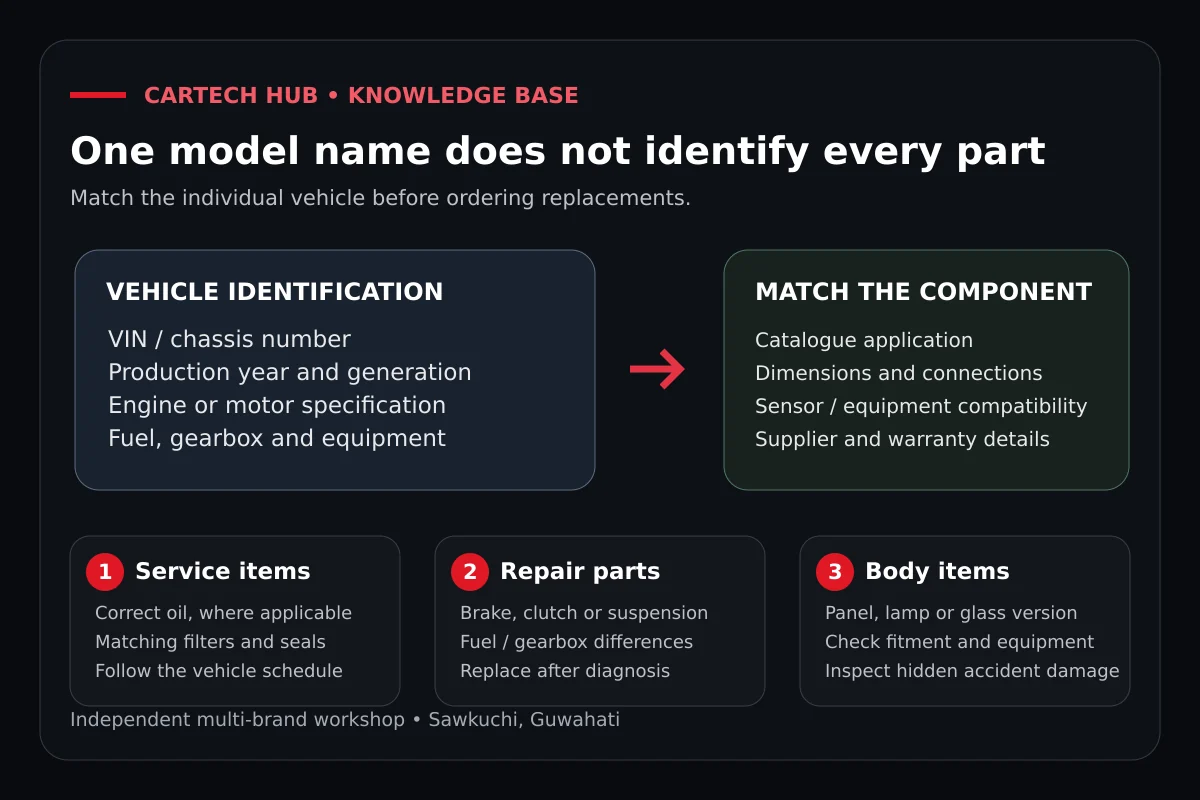
Bring the RC, chassis and engine information, service records and photographs relevant to the complaint. Tata's historical reporting identifies the Grande MKII, but that does not make one component catalogue appropriate to every vehicle carrying a related badge. Check the engine, gearbox and original equipment before requesting a filter, clutch or body part.
Explain whether the vehicle is used personally, for organised passenger transport or in another operating arrangement. Registration, seating configuration and actual use matter to both service planning and insurance. The workshop should not assume that a private-car policy covers every utility vehicle simply because an individual owns it.
Periodic diesel service with evidence behind each item
Consult the applicable handbook for distance- and time-based work. Relevant maintenance may involve the specified engine oil, oil filter, air and fuel filtration, belts, coolant and hose inspections. Diesel fuel-system diagnosis and any glow-plug checks depend on the actual equipment. Petrol spark plugs should not be quoted as a normal diesel service item.
Avoid an unsupported overhaul decision
Record starting behaviour, abnormal temperature, warning indications or performance changes with their operating conditions. Inspect leaks, engine mounts, cooling-system components and relevant sensors as indicated. Injector or other specialist fuel-system work requires the correct resources and diagnostic basis. An unfamiliar sound does not by itself justify an engine overhaul.
Vehicle use on congested Guwahati roads, long-distance routes or periods of storage helps explain inspection priorities. It does not create a universal service interval. Where maintenance history is uncertain, agree on urgent safety work, due scheduled work and condition-based findings separately.
Clutch, gearbox and running-gear inspection
For the manual transmission installed, examine clutch operation, release mechanism, gear engagement and mounts. Clutch plate, pressure plate and release bearing identification should follow the vehicle's specifications. Gearbox and associated driveline complaints need information about speed, load and when the symptom appears before parts are chosen.
Suspension and steering assessment should consider the actual assemblies, prior repairs and reported handling. Dampers, joints, bushes, steering parts and wheel bearings require fitment and condition checks. Do not transfer a passenger-car lower-arm or brake arrangement to the Grande merely to fill a parts list. Fitted brake friction components, drums or discs as applicable, hydraulic condition and any ABS equipment must be identified individually.
AC, electrical and cooling enquiries
Separate insufficient airflow from inadequate cabin cooling. Check the fitted ventilation equipment, cabin filtration where present, blower operation, condenser condition and compressor-related concerns. Engine-cooling inspection can include radiator condition, hoses, fan equipment and leak evidence. These systems have different functions even when a front collision damages both areas.
The low-voltage battery, alternator, starter, lamp circuits, fuses and wiring should be assessed in relation to the complaint. Added audio, lighting or other equipment may change the starting point for diagnosis. Disclose those changes and retain safe circuit protection. Electrical or AC work should have a defined scope rather than an assumption that every older utility vehicle needs the same replacement package.
Accident parts and finish work
A damage survey may consider bumpers, bonnet, fenders, doors, quarter panels, rear closure, lamps, ORVMs and glazing, along with brackets, latches and adjacent supports. Verify the precise Grande version before sourcing. Model-specific body and interior items may have limited availability; obtain a supplier update before agreeing to a firm delivery date.
Denting and painting should be planned after repairability and body alignment are assessed. Prior corrosion, previous filler or non-original panels can alter the estimate. Serious structural or restraint-system damage requires appropriately qualified inspection and referral where needed. Cosmetic improvement is not evidence that all safety-related damage has been resolved.
Insurance assistance begins with the correct policy
CarTech Hub provides Tata accident repair and insurance claim coordination in Guwahati within its confirmed repair scope. Cashless arrangements remain subject to policy conditions, insurer authorisation, survey findings and workshop/network eligibility. Third-party liability cover alone does not fund the owner's accident repairs. Routine servicing, age-related wear and unrelated previous damage are not automatically part of the loss.
Check that the policy's vehicle description and permitted use match the RC and actual operation. Notify the insurer through its designated channel and preserve photographs and incident information. Documents requested may include the policy, registration certificate, driver's licence, claim form, and incident or other reports where appropriate. Additional permit or use-related information may be required for a differently classified vehicle; follow the insurer's instructions rather than assuming private-car requirements.
Agree on survey or inspection before dismantling changes the evidence. The estimate should itemise incident-related parts, panel repair or replacement, labour, paint and diagnosis. Limited supply or hidden damage may require a revised estimate and additional sanction. The insurer makes the approval decision, while the owner independently authorises the workshop to perform the agreed work.
Review deductibles, depreciation, exclusions and non-payables before proceeding. Applicable add-ons have their own terms and limits. Final invoices and claim records should correspond to the authorised work. Delivery checks should address braking, steering, cooling, light operation, closure fit and outstanding concerns, with the vehicle's actual operating role taken into account.
Book a Grande enquiry with useful details
Use the Tata hub, general-service guide, gearbox information and accident-repair process. The Venture guide discusses another vehicle where registration and use need separate confirmation. IndusInd General, formerly Reliance General, guidance and Shriram General information explain the confirmed cashless arrangements and the policy and approval conditions for each claim.
Arrange an appointment, request insurance claim help, call +91 98647 70033 or WhatsApp the RC and vehicle details. Share documents privately through an agreed contact route, not a public review. Our Google profile/reviews page provides feedback information. CarTech Hub is an independent multi-brand workshop, not a claimed Tata-authorised service centre.
Quick answers
Is every Sumo part suitable for a Sumo Grande?
No. Grande identity, production details and the particular assembly must be checked. A shared family name is not a fitment guarantee.
Why should the workshop know whether I carry passengers commercially?
Use and vehicle classification can affect maintenance planning and the applicable insurance requirements. Verify them against the RC and policy.
Can an estimate include old suspension wear under a new impact claim?
The findings must distinguish incident damage from deterioration. Payability is decided under the actual policy and insurer assessment.
Can I expect a fixed collection date before parts are identified?
A reliable timescale requires inspection and sourcing information. Older-model supply and supplementary approval can change the repair schedule.