
In this guide
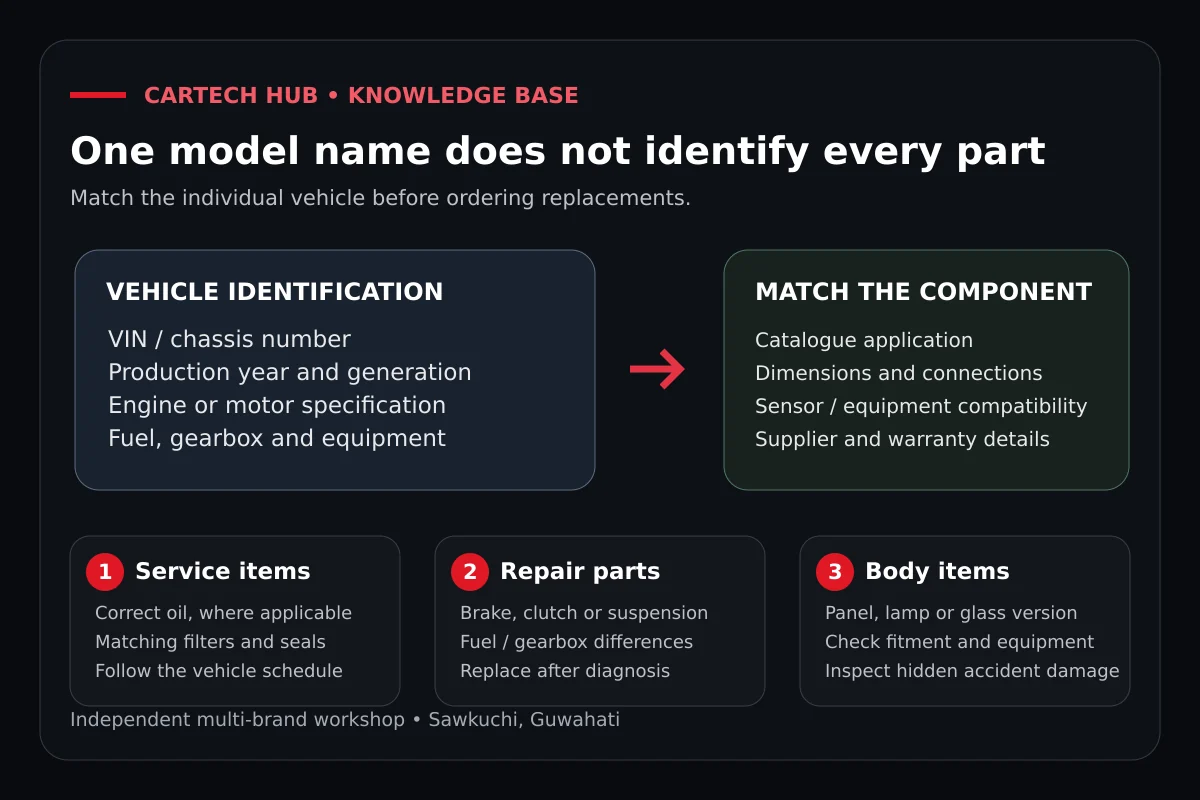
The word Indigo can identify several older Tata sedan configurations, including shorter CS/eCS examples and other body versions. A customer asking for “an Indigo rear bumper” has not yet supplied enough information to order it. At CarTech Hub in Guwahati, good service and accident estimates begin with the vehicle's identity, its previous work and the owner's priorities for continued use.
Establish the version and service record
Use the RC, VIN, build year and fitted engine or fuel system. Petrol, diesel and applicable factory gas configurations must not be given the same engine parts list. Confirm the transmission and identify any previous conversions. Where commercial operation is involved, tell the insurer and workshop the actual use; do not describe a business-use incident as private driving to simplify a claim.
Read the appropriate owner's manual for scheduled service, fluid selection and time-or-distance requirements. Compare the last documented work with the current odometer. Short Guwahati trips and prolonged parking can affect inspection priorities even when the annual distance is modest. Bring invoices rather than relying on “the previous owner serviced everything.” An uncertain history calls for a reasoned baseline, not indiscriminate replacement.
Engine materials and fault investigation
An engine service may involve compatible oil, oil filter, air filter and a fuel filter applicable to the variant. Petrol ignition concerns relate to the correct spark plugs and ignition system; diesel starting and combustion concerns involve appropriate glow, fuel-supply and injection checks. Sensors, engine mounts, belts, gaskets and seals should be selected by engine details and supported findings.
If the car loses coolant or heats up in traffic, examine the radiator, hoses, fan operation and system leaks before choosing parts. A low-coolant warning is a reason for safe assessment, not repeated topping-up while continuing a journey. Engine repair information can help prepare the questions to ask about testing and scope.
Manual driveline and everyday comfort
For a manual Indigo, clutch plate, pressure plate, release-bearing and control-system work depends on fitment and diagnosis. A heavy pedal can arise from release or control issues as well as the clutch itself. Gearbox oil leakage, bearing noise and difficulty selecting a particular gear should be described separately; one complaint does not prove that the entire transmission needs overhaul.
Brake pads or shoes, discs or drums, hydraulic components and ABS sensors where fitted must match the car. Suspension and steering checks may cover struts or shock absorbers, lower arms, ball joints, stabilizer links, bushes, tie rods and wheel bearings. Unstable braking, significant play or wheel damage calls for inspection before the car returns to regular service.
Cabin cooling needs blower and airflow checks alongside refrigeration diagnosis. Where the equipment uses a serviceable cabin filter, establish its correct type. AC compressor, condenser and cooling-fan work must follow a finding. Battery, starter, alternator, lamps, fuses and wiring deserve attention when starts are slow or electrical behaviour is intermittent. Disclose taxi meters, audio systems or other added electrical loads.
Body parts that cannot be chosen by badge alone
Indigo body work can involve the bonnet, bumper assemblies, fenders, doors, quarter panels, boot lid, lights, ORVM and windshield. Boot and rear-quarter geometry differ across body versions. Confirm the exact part reference, attachments and connections; do not assume a Manza panel or a hatchback tailgate is an Indigo equivalent.
An accident repair estimate should record panel gaps, lamp mounts, underbody concerns and cooling or suspension damage related to the impact. Repairs and replacements need separate reasons. CarTech Hub can discuss body refinishing, but major alignment, restraint or unsafe corrosion problems require a confirmed specialist assessment. Parts supply, workmanship scope and any agreed alternative sourcing must be clear before the customer accepts the job.
Indigo insurance assistance: the claim file and the customer's share
CarTech Hub offers Tata accident repair and documentation assistance in Guwahati. An Indigo owner with United India Insurance, Shriram General or another motor policy should check the applicable own-damage terms and contact channel. United India guidance here is for existing-policy planning; it does not promise a fresh sales channel or confirmed CarTech Hub cashless network status.
Arrange a damage inspection, notify the insurer and gather the policy schedule, RC, driver's licence, incident photos and claim form. Reports or extra evidence may be required for the particular incident. Preserve the vehicle for survey or insurer inspection before avoidable stripping. Submit an itemised estimate that distinguishes parts, panel labour, paint and related mechanical work, and seek supplementary approval if additional accident damage appears.
Do not begin the approved scope without both insurer authorisation where required and the owner's repair consent. At completion, send the final documents, reconcile the claim payment and discuss the customer's deductible, depreciation, consumables or other excluded costs. Inspect the repaired areas and receive the invoice at delivery. Process details vary by policy and incident. Cashless handling is conditional on insurer approval, survey findings, policy conditions and workshop/network eligibility; third-party-only cover does not pay for damage to your own Indigo, and gradual wear is not automatically covered.
Discuss the car before arranging arrival
Schedule an Indigo assessment or request claim coordination. Call +91 98647 70033 or WhatsApp the build and incident details; the review information helps customers evaluate CarTech Hub. Work is offered as independent multi-brand assistance, without a claim of authorised Tata affiliation and subject to confirmed capability.
Quick answers
Does “Indigo” alone identify the correct rear bumper?
No. The body version, build year and reference must be checked. CS/eCS and other sedan versions cannot be treated as a universal rear-body parts group.
What if the Indigo has been used as a taxi?
Disclose its actual usage and policy classification. Service history and insurance requirements should reflect the vehicle that is being repaired, not a simplified description.
Can a stiff clutch pedal justify replacing the full clutch immediately?
The control and release mechanism should also be examined. Ask the workshop to identify the finding and explain whether assembly replacement is needed.
Why may I owe money even on an approved claim?
Policy deductibles, depreciation and excluded items may remain with the customer. Obtain a breakdown rather than treating approval as a promise of a zero-cost repair.