In this guide
Two later Ford Figos can look much alike while needing different transmission advice and engine service parts. That is why CarTech Hub asks for more than a model name when a Guwahati owner reports hesitation, a warning light or an accident. The aim is a useful repair decision for your car, with the relevant variant recognised before a part is ordered or a major job is authorised.
Describe the generation and fitted equipment
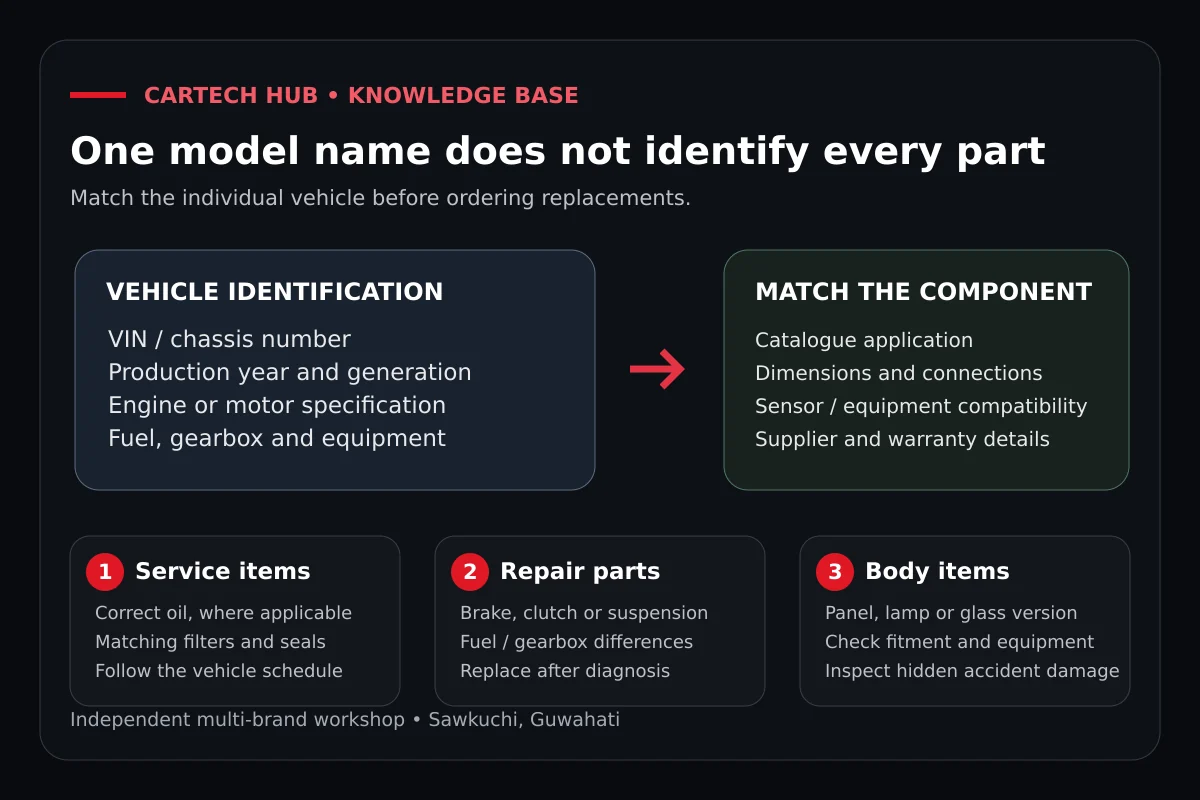
The second-generation Indian Figo included petrol and diesel versions across different model years. Engine and automatic-transmission offerings changed during its life. Record the VIN, build year, fuel and transmission description from the vehicle documents and correct Ford manual. A registration year can differ from the manufacturing year and should not settle compatibility by itself.
Do not group every automatic together
Earlier dual-clutch and later conventional automatic applications need different diagnostic procedures and parts decisions. Confirm which unit is fitted instead of relying on an advertisement that says simply “Figo automatic”. Manual vehicles have their own clutch and gear-selection checks. Symptoms observed during parking, acceleration or a hot restart should be described separately.
Keep maintenance appropriate to the actual engine
A periodic service plan considers the correct time-and-distance requirements and the use pattern. Stop-start traffic, repeated short journeys, long storage and dusty conditions can justify a discussion of inspections under the relevant manual. Select engine oil and its filter for the specified engine; assess the air filter, fitted fuel-filtration arrangement and cabin filter where provided.
Petrol ignition servicing can involve spark plugs and coils. Diesel fuelling and applicable glow-plug checks are different tasks. Belts, the timing-drive arrangement, sensors, mounts and coolant requirements must be identified correctly. Do not apply one engine's maintenance instructions to another or approve a parts package just because the bonnet badge is familiar.
Separate a running fault from a transmission fault
A hesitation during acceleration may involve engine operation, electrical supply or transmission control. Computer-assisted diagnosis should record fault codes and supporting test results, rather than selling a component based on one code. Injection, ignition, intake or sensor concerns are examined for the fitted petrol or diesel engine. Turbocharger checks are relevant only where the engine actually has one.
For a manual Figo, slipping, difficult selection and changes in pedal feel can guide assessment of the clutch plate, pressure plate, release bearing and associated mechanism. Flywheel condition, gearbox mounts, driveshafts and CV joints are considered where the complaint supports them. Automatic work requires suitable knowledge, equipment and confirmed workshop capability; specialist referral may be preferable to speculative dismantling.
Look after braking, suspension and the front axle
A braking complaint deserves an examination of the fitted pads, discs, rear braking components, calipers, hydraulics and fluid condition. ABS sensor or wiring faults require evidence. Uneven tyre wear or pulling is also considered alongside wheel condition, suspension joints and alignment, with worn components repaired before final adjustment.
Lower or control arms, ball joints, stabilizer links, bushes, struts or shock absorbers and wheel bearings can affect ride and steering response. Correct tie-rod and steering-system parts depend on the vehicle. A new bearing is not the automatic answer to every road-speed noise; inspection should locate the source and check related wheel or brake issues.
Treat cooling, AC and starting complaints as separate jobs
Coolant loss prompts examination of hoses, radiator, water pump, thermostat and cooling-fan operation as relevant. Engine cooling work should follow evidence of leakage or poor operation. An overheating warning needs a safe response and assistance, rather than continuing to drive to see if it clears.
For the cabin, airflow and refrigerant-system diagnosis guide any compressor, condenser, evaporator or blower repair. A recharge alone does not fix a leak. Battery testing, starting current, charging output and connection checks distinguish a weak battery from alternator, starter, relay or wiring faults. Headlights, tail lights and switches are matched to the appropriate year and trim.
Specify the body repair and parts standard
A later Figo bumper, grille, lamp or bracket must match the actual version. A front impact can extend to the bonnet, fender, cooling pack or support structure, while rear damage may involve the tailgate, lamps and quarter panels. Doors, ORVMs and glass require checks when struck. Ask for a written accident estimate that identifies repaired and replaced items separately.
Panel preparation, corrosion protection, colour matching and paint finishing are agreed alongside fit and function. Existing damage is recorded so the new incident is not confused with earlier repairs. If impact affects restraints, safety structure or systems needing specialist procedures, confirm qualified assessment or referral. Spare-part compatibility, quality and availability should be explained without inventing a stock guarantee.
Insurance Claim Assistance Available – Cashless Eligibility to Be Confirmed
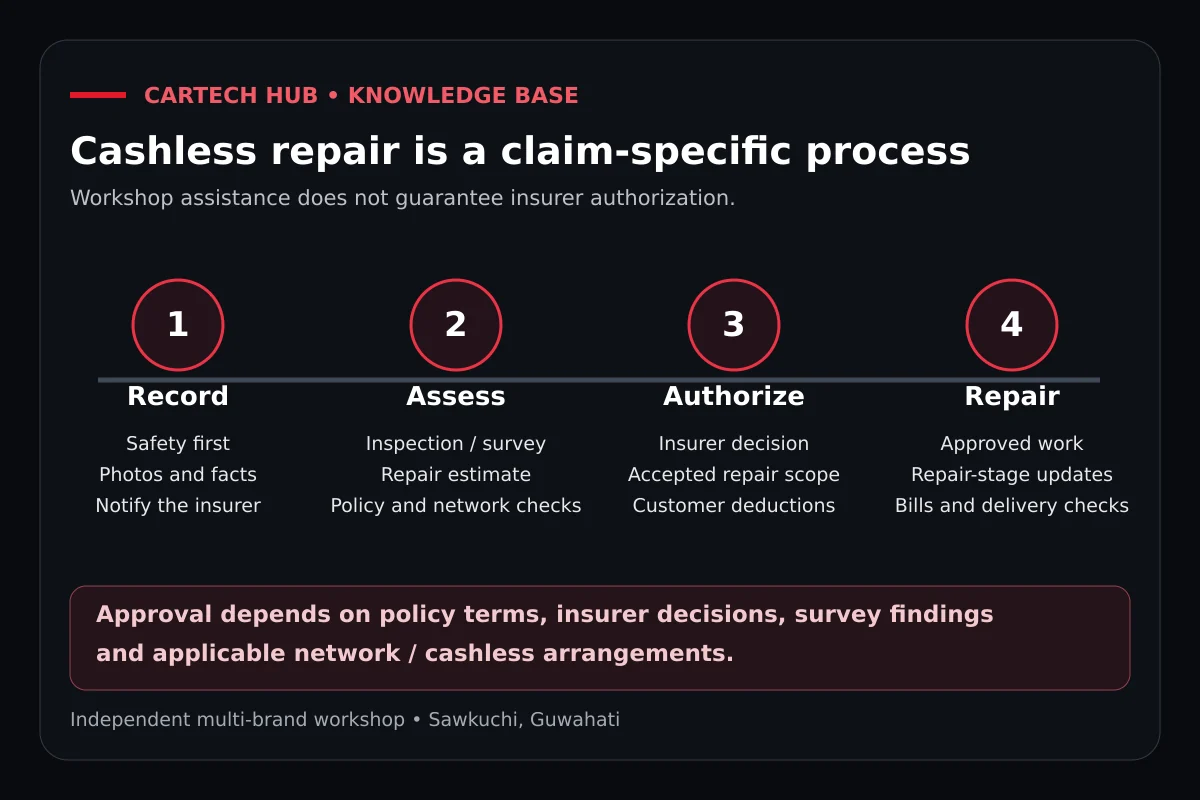
Start a Ford Figo claim enquiry with CarTech Hub by sharing the vehicle identity, accident details and policy information. Following safe inspection, intimate the claim through the insurer's required channel. Provide the requested policy, registration certificate, relevant driving licence, claim form and photographs. Police documents or additional evidence may be needed for particular circumstances.
A survey or insurer inspection can be necessary before opening the damaged area. The estimate lists accident-related parts, labour and paint work for insurer consideration. Hidden damage may need a supplement and another authorisation. Obtain the relevant insurer decision and your consent to the scope and customer costs before approved repairs, replacement and painting proceed.
For example, ICICI Lombard guidance and Royal Sundaram enquiries are starting points for checking an actual policy, not evidence that every policy has cashless access here. CarTech Hub provides Ford accident repair and insurance claim assistance in Guwahati; cashless eligibility depends on policy conditions, insurer approval, survey findings and applicable workshop/network arrangements. Third-party-only cover is not own-damage insurance, and routine clutch wear or mechanical maintenance does not become insured simply because an accident claim is open.
Complete the final claim documents after the agreed repairs and review the settlement against the invoice. Applicable deductibles, depreciation and excluded or unrelated items can remain payable. Settle the agreed owner share and complete delivery checks. Insurer instructions and accident circumstances may change the sequence or documentation.
Bring clear information to the appointment
Reserve a workshop inspection, or open a Ford insurance claim enquiry. Phone +91 98647 70033 for a practical discussion and WhatsApp the vehicle and damage details when convenient. Read the workshop reviews and browse the Ford model directory. CarTech Hub is an independent multi-brand workshop serving Guwahati and customers from nearby Assam locations; confirm specialist requirements before travelling.
Quick answers
Why does the workshop need my later Figo’s manufacturing year?
The same model name can cover changed engines, lamps and transmission equipment. The build information and VIN reduce the risk of ordering an incompatible part.
Can one fluid or repair procedure suit every automatic Figo?
No. The actual transmission must be identified. Specifications, diagnostic steps and specialist requirements can differ between automatic applications.
Will a scan alone establish why my Figo hesitates?
A scan provides useful information but needs supporting tests and symptom checks. Engine, electrical and transmission faults can sometimes feel similar to the driver.
Can a claim include a worn clutch discovered during accident work?
Not automatically. The insurer considers policy coverage and evidence linking damage to the insured event; routine wear or unrelated faults may remain the owner’s responsibility.