
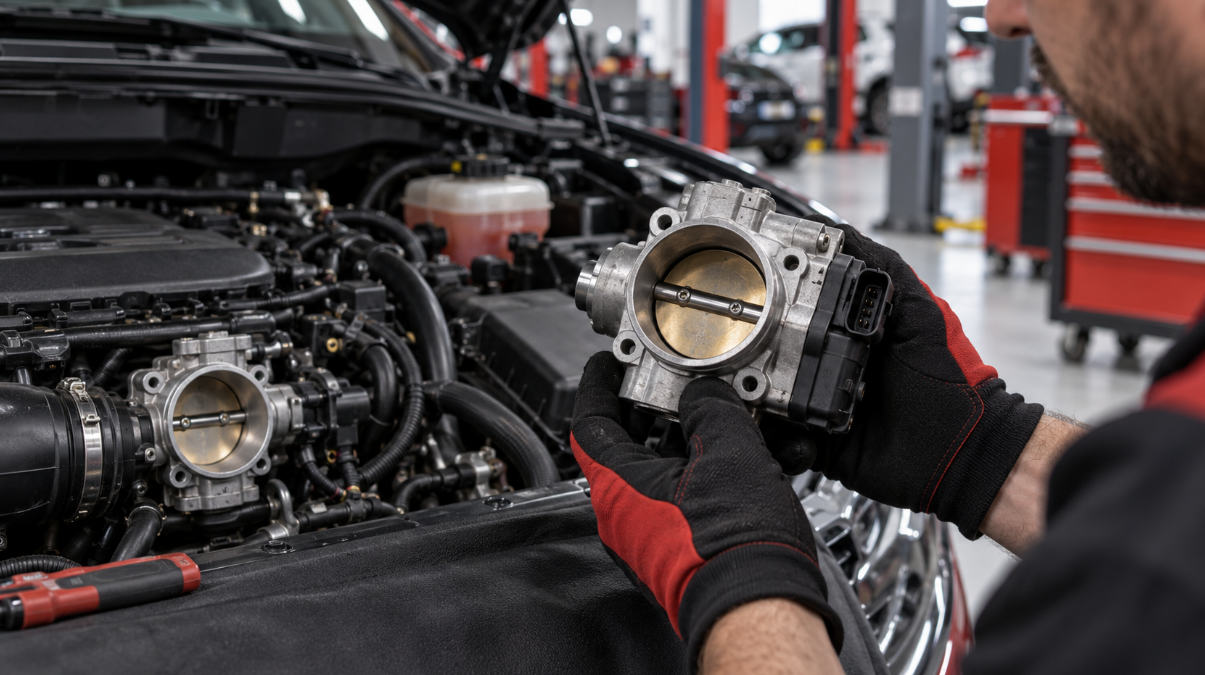
The throttle body controls how much air enters your car’s engine when you press the accelerator. If it becomes dirty, damaged or electronically faulty, the engine may not receive the correct amount of air. This can affect performance, fuel efficiency and driving safety.
Here are nine common symptoms of a failing throttle body:
1. Check Engine Light
A faulty throttle body, throttle-position sensor or electronic actuator may activate the Check Engine warning light. A diagnostic scan is necessary to identify the exact fault code.
2. Rough or Unstable Idling
The engine may shake, vibrate or repeatedly change RPM while the vehicle is stationary. Carbon deposits inside the throttle body can restrict airflow and cause an unstable idle.
3. Poor Acceleration
If the car responds slowly or lacks power when you press the accelerator, the throttle plate may not be opening correctly. This can make overtaking or entering fast-moving traffic unsafe.
4. Engine Stalling
A defective or severely dirty throttle body may cause the engine to stall while idling, slowing down or stopping at a traffic signal.
5. High or Fluctuating RPM
The engine speed may remain unusually high or rise and fall without any accelerator input. This may indicate a sticking throttle plate, air leak or faulty electronic throttle control.
6. Increased Fuel Consumption
Incorrect airflow can disturb the air-fuel mixture and force the engine to consume more fuel. A sudden reduction in mileage should not be ignored.
7. Jerking, Hesitation or Surging
The vehicle may jerk, hesitate or accelerate unevenly while driving. This can happen when the throttle body sends inconsistent airflow or position information to the engine control unit.
8. Limp Mode or Reduced Engine Power
Modern vehicles may enter limp mode when the system detects a serious electronic throttle fault. Acceleration becomes limited, and a “Reduced Engine Power” or similar warning may appear.
9. Difficulty Starting the Engine
An incorrect amount of air during startup can cause delayed starting, repeated cranking or immediate stalling after the engine starts.
How Is a Throttle Body Problem Diagnosed?
A proper diagnosis may include:
• Scanning the vehicle for diagnostic trouble codes
• Inspecting the throttle body for dirt and carbon deposits
• Testing the throttle-position sensor and electronic actuator
• Checking electrical connectors, wiring and vacuum leaks
• Examining related components such as the air filter and intake system
• Performing throttle relearning or calibration when required
Should the Throttle Body Be Cleaned or Replaced?
A dirty throttle body may only require professional cleaning and recalibration. However, replacement may be necessary if its motor, sensor, gears, wiring or internal electronic components are damaged.
Do not replace the throttle body based only on symptoms. Similar problems can also result from faulty spark plugs, fuel injectors, airflow sensors, vacuum leaks or other engine-management faults.
If your vehicle shows these symptoms, visit CarTech Hub for computerized diagnostics and professional throttle-body inspection in Guwahati. Early diagnosis can help prevent breakdowns, unnecessary fuel consumption and further engine-performance problems.