
In this guide
A Tata Sumo used for family transport or longer journeys across Assam deserves an inspection plan suited to an older utility vehicle. CarTech Hub in Guwahati can discuss servicing, parts replacement and accident estimates, but the Sumo name covers different versions and equipment. The actual vehicle, its usage and its condition must determine the scope, particularly before a journey into Northeast India's hills.
Identify the version, load and service history
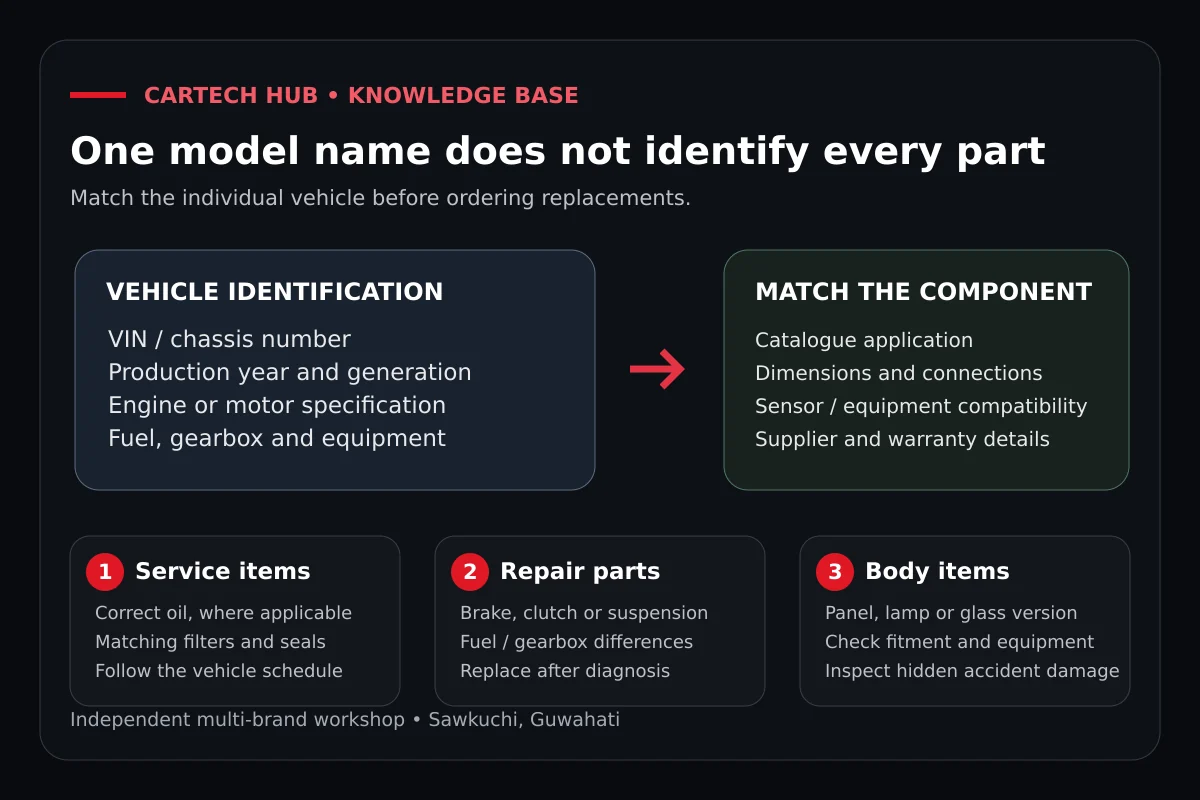
Provide the build year, VIN, engine, registration class, transmission and drivetrain details. Original, Victa or Gold identification should be established rather than guessing from a painted badge. Sumo Grande or Movus should also be distinguished from this older Sumo family; chassis and body assumptions must not be transferred automatically. Tell the workshop whether the vehicle is privately or commercially used and what passenger or load pattern is typical.
Review the correct owner's handbook for maintenance governed by elapsed time and distance. Bring records of engine service, cooling work, brakes and driveline attention. A Sumo parked for weeks can still require checks before resuming use, while high mileage alone does not prove which components are worn. CarTech Hub should explain priorities and capability before accepting a long list of replacements.
Engine and cooling service on the actual diesel
The Sumo Gold was documented with a 3.0-litre CR4 diesel, while earlier Sumo versions used different engine configurations. Diesel Sumo engine types and fuel-system equipment therefore need version-specific identification. Verify oil specification, oil filter, air filter and fuel-filter fitment. Injection diagnosis, applicable glow equipment, belts, mounts, gaskets, seals and sensors should reflect that engine. Petrol spark plugs should not appear on a diesel service list, and an older diesel should not be assigned the electronics or emissions equipment of a newer SUV by assumption.
Cooling assessment may involve the radiator, fan arrangement, hoses, coolant condition, leak sources and related pump or thermostat concerns. Persistent temperature problems on climbs or under load deserve investigation before another trip. Stop safely for an overheating warning and arrange advice rather than repeatedly testing the vehicle with passengers aboard.
Clutch, driveline and roadworthiness
A manual Sumo clutch job must match the plate, pressure plate, release bearing and control arrangement to the drivetrain. Describe slipping, engagement noise or difficult shifts accurately. Gearbox leakage, mounts and applicable propeller-shaft joints or support components may be relevant to vibration. For a four-wheel-drive example, identify the transfer and drive configuration before recovery; do not assume that towing with particular wheels on the road is safe.
Brakes need inspection of the fitted pads or shoes, discs or drums, hydraulics and ABS equipment only where present. Suspension may use components different from a hatchback, including version-specific springs, bushes, dampers and mounting points. Steering parts and wheel bearings need condition checks, with tyre and wheel suitability reviewed for the actual vehicle and load. A generic lower-arm or stabilizer-link replacement bundle is not evidence-based Sumo maintenance.
AC, where equipped, may need airflow and refrigerant-system diagnosis appropriate to the cabin arrangement. Compressor, condenser, blower and electrical control checks should precede parts replacement. Battery, starter motor, alternator, lamps, earth connections, fuses and wiring deserve attention where starting or lighting is unreliable. Added passenger equipment or accessories should be disclosed to avoid overlooking altered circuits.
Utility body parts and accident damage
Sumo front and rear bumpers, bonnet, fenders, doors, rear door or tailgate arrangement, quarter-body areas, lamps, mirrors and windshield need exact version checks. An older body can combine recent damage with previous repairs or corrosion. Confirm compatible mounting points, component condition and sourcing terms; availability is not guaranteed because a part appears in an online listing.
An accident inspection should distinguish outer-panel damage from frame, body-mount, suspension or driveline concerns. Repair feasibility and specialist alignment requirements must be settled before denting and painting is treated as the final task. Severe structural or restraint-related work should have a qualified repair route, and CarTech Hub must confirm whether the requested procedure can be undertaken or needs referral.
Sumo insurance assistance with correct use declared
CarTech Hub provides accident repair and insurance claim assistance for Tata vehicles in Guwahati. Customers insured with Oriental Insurance, Universal Sompo or another motor insurer should use the policy applicable to the actual vehicle use. A private policy cannot simply be assumed suitable for every passenger-carrying operation. No all-insurer cashless relationship is claimed here.
Contact the workshop for damage recording, intimate the insurer and collect the policy, RC, driver's licence, photographs and claim form. Commercial-use documentation or incident reports may also be requested depending on the claim. Preserve the vehicle for survey or insurer inspection before unnecessary dismantling. Prepare an itemised estimate for parts, mechanical repairs, panel labour and paint; hidden damage requires documentation and any supplementary approval.
Obtain insurer authorisation where required and the owner's separate repair consent before the approved job starts. Complete approved repairs, submit final paperwork, explain the customer's deductibles, depreciation and non-payable amounts, and inspect the vehicle at delivery. The precise steps vary by policy and circumstances. Cashless handling depends on policy conditions, survey findings, insurer approval and workshop/network eligibility. Third-party-only cover does not pay for your own Sumo's accident repair, and ordinary mechanical wear is not automatically a covered loss.
Discuss the visit or recovery before travelling
Book a Sumo assessment, send a claim enquiry, call +91 98647 70033 or WhatsApp the version details. Consult the CarTech Hub review information when planning your visit. We are an independent multi-brand workshop in Guwahati, Assam, not an asserted authorised Tata service centre; confirm work scope and recovery arrangements first.
Quick answers
Does this guide make Sumo Grande and older Sumo parts interchangeable?
No. Identify the exact family and version. Drivetrain, body and suspension parts must be verified for the actual vehicle instead of ordered by the Sumo name alone.
What should I disclose when a Sumo carries paying passengers?
Tell the workshop and insurer the real registration and usage. The applicable policy and any required commercial documents should reflect the incident and vehicle accurately.
Can any towing method be used for a four-wheel-drive Sumo?
No. The drivetrain and manufacturer recovery guidance must be established first. Discuss a safe professional recovery method rather than assuming wheel-on-road towing is suitable.
Is a straight-looking outer body enough after an accident?
It is not conclusive. Frame, mounting, suspension and driveline condition may need inspection, with specialist assessment where damage or safe repairability is uncertain.