
In this guide
The Tata Estate belongs to an earlier chapter of Tata's passenger-vehicle history. Keeping one usable today requires attention to the actual car's condition, previous alterations and the availability of suitable parts. Owners seeking Tata Estate service in Guwahati can contact CarTech Hub for an initial discussion of independent inspection and accident-repair assistance. The name on the registration certificate is the starting point, not a promise that every restoration task or obsolete component can be supplied.
Begin with documentation and a condition record
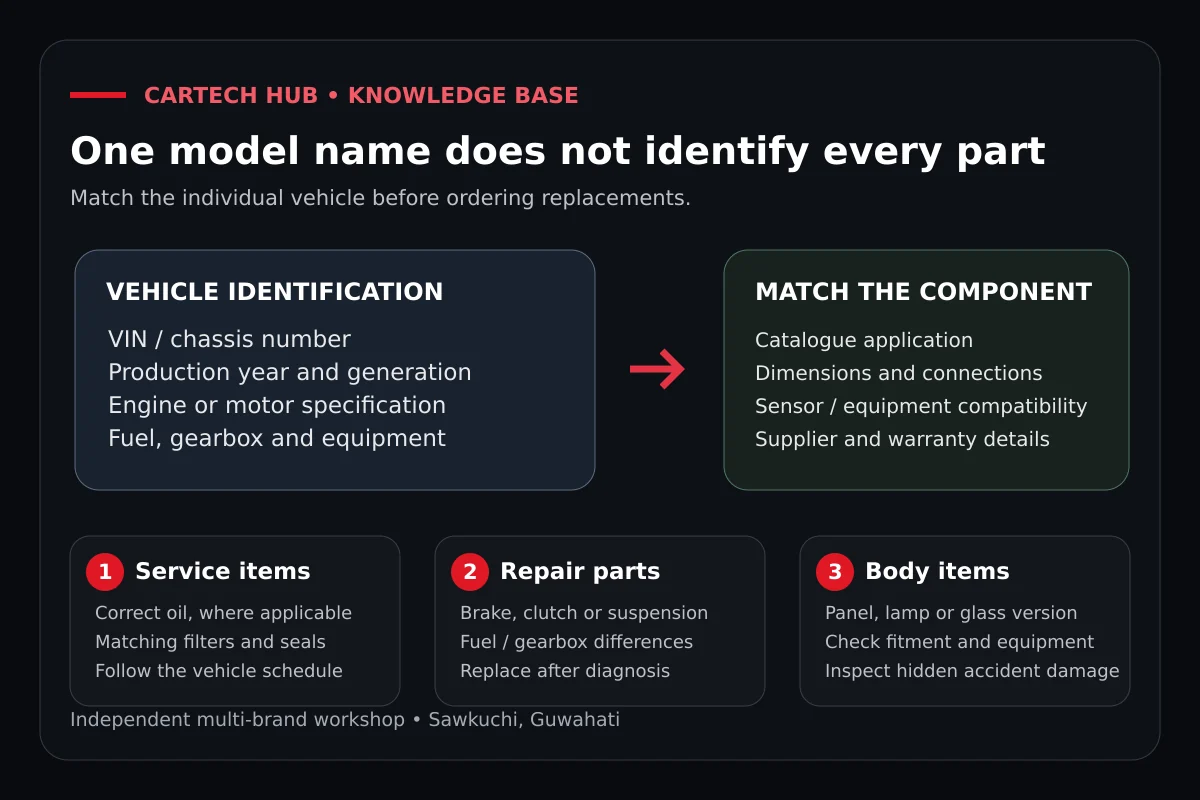
Provide the chassis number, registration details, engine information and photographs of the vehicle and concern. Retain any handbook, service invoices and records of past body or mechanical work. Identify non-original equipment before a parts enquiry; an old wagon may have accumulated repairs that make a catalogue assumption unsafe.
The Estate must not be confused with the later Indigo Marina. Their shared wagon description does not establish interchangeability. Establish the actual engine, manual transmission and driveline arrangement using reliable vehicle information. If original documents are incomplete, agree which identification checks are needed before an estimate can be meaningful.
Set maintenance priorities without inventing a schedule
Use the correct manufacturer's instructions and verified engine information to decide specified lubricant, engine-oil filter, air filtration, applicable fuel filtration and other scheduled work. Cooling hoses, belts, seals and connections should be inspected for actual condition. A diesel vehicle does not need petrol spark-plug servicing; injection equipment and any glow-plug components must be identified before specialist attention is proposed.
Time and storage can matter more than mileage
A lightly used Estate may still have deteriorated tyres, old fluids, weak battery performance or corroded connections. Describe the storage environment and how often the vehicle is driven. Guwahati's wet-season conditions should form part of the inspection conversation, without assigning an invented severe-use interval to every car.
Record any temperature change, starting difficulty, leakage or warning indication before approving replacements. Radiator, cooling fan, water-circulation components and hoses should be examined according to the installed equipment. An engine overhaul requires evidence and an agreed specialist scope, not the assumption that age alone proves internal damage.
Identify clutch, gearbox and road-safety components
For the manual drivetrain actually installed, inspect clutch operation, release components, mounts and gear engagement. Verify a clutch plate, pressure plate or release bearing against the actual assembly. Gearbox or other driveline noises need a description of when they occur and inspection findings before dismantling is authorised.
Brake friction components, hydraulic condition, steering connections, suspension parts and wheel bearings require their own applicability checks. Do not presume modern ABS provision or list a particular sensor as standard equipment. Likewise, a generic passenger-car suspension list does not identify the Estate's actual components. Safety concerns should take priority over trim restoration, with recovery considered if the vehicle should not be driven.
Assess the equipment actually fitted
AC service depends on the system installed and any past conversion. Identify the compressor, condenser, blower and associated equipment before requesting parts. Cabin filtration should be discussed only where fitted. Weak airflow, lack of cooling and electrical control concerns are different diagnostic routes.
Battery, alternator, starter motor, lamps, wiring and protective devices may need checks based on symptoms. Old accessory installations can obscure a fault or create unsafe connections. Explain any non-original equipment, and require a repair that preserves proper circuit protection. CarTech Hub should confirm whether particular legacy-system work can be accepted or needs referral.
Older-wagon body work needs a supply strategy
Inspect bumpers, bonnet, fenders, doors, quarter panels, rear closure, lamps, ORVMs, windshield and other glazing appropriate to the actual Estate. Body hardware, seals, hinges and latches can be as difficult to source as the visible panel. A supplier's verbal reassurance should be followed by fitment confirmation and realistic lead-time information.
Denting and painting should distinguish local damage from extensive restoration. Existing corrosion, previous repairs or poorly supported panels may alter the scope after assessment. Structural or safety-related concerns require suitable specialist evaluation before a cosmetic finish is planned. The workshop should explain repair options, sourcing uncertainty and limitations rather than promise a complete like-new result.
Insurance: value the evidence and understand the cover
CarTech Hub in Guwahati can assist with accepted Tata accident repairs, repair estimates and requested claim records. Cashless repair depends on policy conditions, insurer approval, survey findings and workshop/network eligibility. Third-party-only insurance does not pay for damage to the owner's Estate. A restoration project, ordinary wear and pre-existing corrosion are not automatically insured accident losses.
Notify the insurer through the policy's official contact route and preserve the incident evidence. Requested documents may include policy details, RC, driving licence, claim form, damage photographs and relevant reports where necessary. Understand the survey requirements before dismantling or body work changes the visible condition. The workshop's role is assistance with technical repair information, not a guarantee of claim acceptance.
The estimate should separate new accident damage, previous deterioration, repair versus replacement choices, paint work and labour. It should also make parts-supply uncertainty clear. Hidden damage or a different sourcing route may need supplementary approval. The insurer decides admissibility and sanctioned amounts; the owner separately consents to the agreed repairs and payment responsibilities.
Review insured value, deductibles, depreciation and non-payables using the actual policy. Do not assume a zero-depreciation benefit or a universal settlement percentage for an old vehicle. If extensive damage or unavailable components complicate the case, seek the insurer's written guidance on viable settlement and repair options. Retain final invoices, revisions and claim papers. Collection should include the agreed safety, cooling, electrical and body-closure checks, with unresolved limitations disclosed.
Plan an appointment rather than an assumed restoration package
Browse the Tata model directory, general-maintenance guide, parts-fitment page and electrical-service information. The Indigo Marina article shows why a different wagon needs a different plan. New India Assurance guidance explains the confirmed cashless arrangement and the conditions for an individual repair claim.
Book a vehicle assessment, enquire about an accident claim, call or WhatsApp the Estate's details. Use the Google profile and reviews page for customer-feedback information. CarTech Hub provides independent multi-brand service in Guwahati, with no claimed Tata-authorised status; specialist resources and older-model parts supply must be confirmed.
Quick answers
Does a low-mileage Estate need time-based maintenance?
Yes, applicable time-based requirements and condition checks still matter. Storage and age do not disappear because distance is low.
Can Marina body parts be assumed to fit an Estate?
No. They are different vehicle families. Verify the actual body and mechanical assembly before purchasing any substitute.
Will insurance fund a complete restoration after a minor impact?
The claim concerns admissible incident damage under the policy. Restoration, corrosion and unrelated wear should be recorded separately.
What should I ask when an original component is unavailable?
Request verified sourcing or a suitable repair proposal, its limitations, lead time and any insurer authorisation needed for the revised approach.