
In this guide
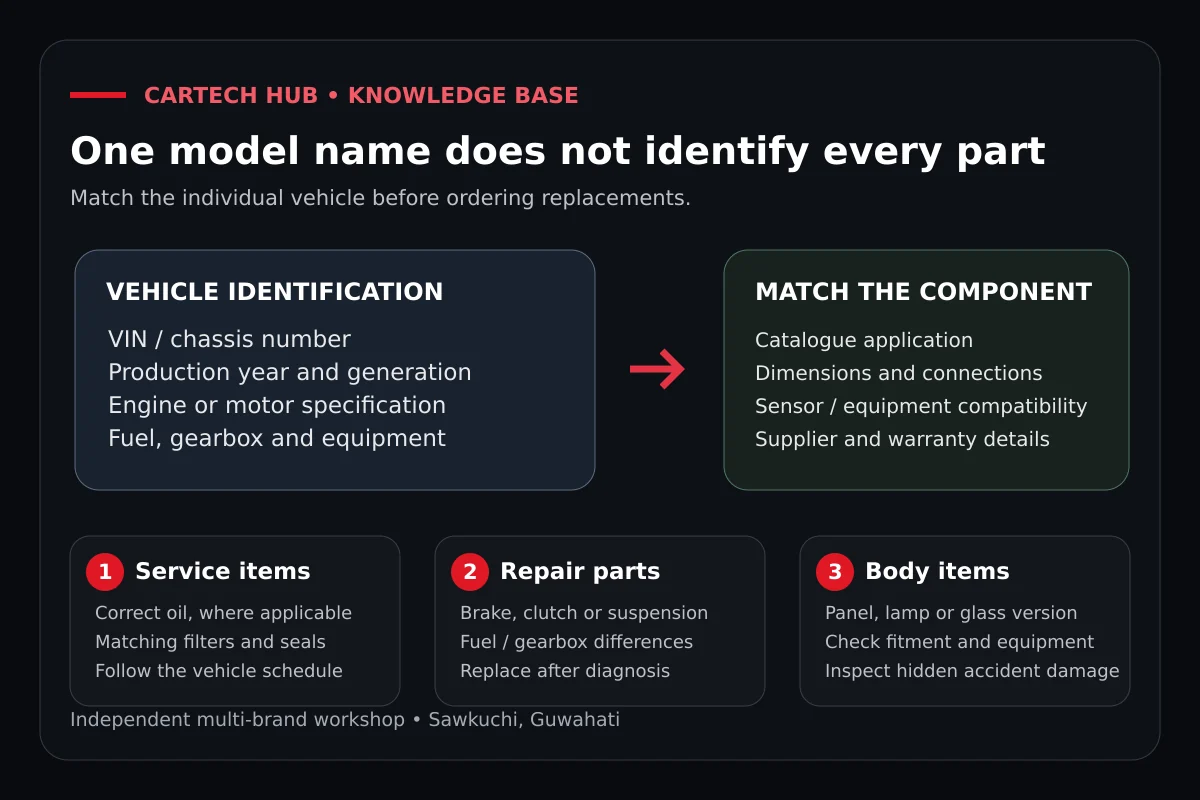
Tata Indigo CS and eCS owners should give the full vehicle details when requesting service. These compact-sedan names refer to a family with production changes, not one unchanging engine or parts catalogue. Tata's historical information also distinguishes the Indigo CS from the Manza and Marina. CarTech Hub in Guwahati can help plan independent maintenance, body repairs and insurance paperwork for the actual CS/eCS vehicle after its identity and workshop requirements are checked.
Use records to separate the CS/eCS versions
Share the RC, vehicle identification number, manufacturing details and fuel type. Petrol and diesel equipment must not be combined into a universal parts list. Identify the engine, transmission and any recorded changes before requesting an injector, filter, clutch or cooling component.
Past invoices can be valuable on a vehicle that has changed owners. Note when scheduled servicing was last completed and whether there were previous body repairs or non-original accessories. An old part marked “Indigo” is not enough to establish fitment for a compact-sedan version. Check the relevant manufacturer manual and vehicle-specific parts information instead.
Periodic service starts with fuel-specific requirements
Engine oil, oil filter, air filter and applicable fuel-filter work should follow the correct maintenance schedule. Cabin/AC filtration, belts, cooling hoses and fluid checks also depend on the installation. Replace petrol spark plugs only where specified for the petrol engine; diesel injection and any glow-plug checks follow different equipment and symptoms.
Do not turn a symptom into a predetermined part order
Describe starting difficulty, temperature changes, a warning light or reduced performance with the conditions in which it occurs. Injectors, sensors and engine mounts may be relevant inspection items, but the complaint alone cannot establish that they need replacement. Cooling checks should consider radiator condition, fan operation, hoses and evidence of leakage before assuming major engine damage.
Owners using the car for frequent short journeys around Guwahati should explain that pattern. Storage and service time can also matter, even if the odometer has not moved far. This article does not prescribe one oil grade or fixed interval for every CS/eCS variant.
Clutch and manual gearbox diagnosis
For the manual drivetrain actually fitted, consider clutch engagement, release action, gear selection and mounting condition together. A clutch plate, pressure plate or release bearing should be identified for the correct version. The operating mechanism and related components also need assessment where indicated.
A difficult shift should not automatically lead to internal gearbox replacement. Record whether the concern appears in one gear, while stationary, when hot or during acceleration. Transmission mounts and driveshaft/CV-joint components, where applicable to the actual assembly, should be considered using inspection evidence. Confirm the scope before approving dismantling.
Brake, suspension, AC and electrical enquiries
Inspect the fitted brake pads, discs, rear friction components and hydraulic condition. Some braking equipment or ABS provision differs by variant; do not quote sensors or assemblies as though every example has the same specification. Dampers, arms, bushes, steering joints and wheel bearings require condition and fitment checks when noise, looseness or tyre wear is reported.
For AC work, the blower and airflow path are distinct from the refrigerant circuit and compressor. A condenser damaged in a collision needs its own assessment. Battery condition, alternator output, starter operation, fuses, relays and wiring faults should be examined with attention to previous accessory work. Electrical repair should correct the cause, not bypass protective devices.
Compact-sedan body parts need their own fitment check
An accident estimate may include front or rear bumper, bonnet, fender, doors, quarter panels, boot lid, lamps, mirrors or glazing. Do not describe this sedan's rear closure as a hatchback tailgate. Check supporting brackets, latches, weather seals and nearby components before deciding that a dented outer panel is the complete job.
Denting and painting can be planned after panel repairability, prior corrosion and body alignment are assessed. The shorter compact-sedan body should not be assumed to share every rear-body part with a different Indigo derivative. Obtain supplier confirmation and lead times; the article does not promise immediate CS/eCS stock. Significant structural or restraint damage may need specialist referral.
Insurance claims for an Indigo CS/eCS accident
CarTech Hub provides Tata accident-repair and insurance claim assistance in Guwahati within its confirmed scope. Cashless repair depends on the insurer's approval, the policy conditions, survey findings and workshop/network eligibility. Third-party-only cover does not pay for repairs to your own car. Clutch wear, ageing filters and other maintenance requirements are not automatically part of an accident settlement.
Intimate the claim through the contact process on the policy. Preserve photographs and describe the event accurately. The insurer can request policy documents, RC, driving licence, claim form, incident information and additional reports where necessary. Understand whether inspection or survey must precede dismantling and retain evidence of hidden damage if further work is authorised.
An itemised estimate should identify incident-related parts, repair-versus-replacement decisions, labour, paint work and any pre-existing service concerns. Parts sourcing and extra findings may require a revised estimate or supplementary approval. Insurer sanction and the owner's consent to the workshop's work are separate. Agree how uncovered repairs will be handled before work begins.
Review deductibles, depreciation and non-payable amounts using the actual cover, rather than assuming every old car is eligible for zero-depreciation settlement. If the RC or use differs from private personal use, the insurance must suit that classification and the circumstances. Final documentation and delivery checks should cover completed work, light operation, closure fit, brakes, steering and unresolved concerns.
Take the next step with CarTech Hub
The Tata model hub, general-service page, brake information and electrical repair guide provide related routes. Read the Indigo Marina article to see why another Indigo body requires independent fitment decisions. Cholamandalam MS guidance and Universal Sompo information explain policy enquiries without confirming all-insurer cashless arrangements.
Make an appointment, ask about an accident claim, call +91 98647 70033 or WhatsApp the vehicle information. Our Google profile/reviews route supports customer feedback. CarTech Hub offers independent multi-brand service in Guwahati and does not describe itself as an authorised Tata Motors workshop.
Quick answers
Is an Indigo CS/eCS the same parts reference as a Manza?
No. Confirm body, engine and production details for the actual vehicle. Tata’s historical range descriptions distinguish these models.
Should diesel service include a petrol spark-plug set?
No. Petrol ignition and diesel fuel-system equipment are different; the correct engine identity determines applicable parts.
Can accident insurance also pay for a worn clutch?
Wear is not automatically an insured incident. Keep maintenance findings separate and apply the policy to the supported accident damage.
Why does the workshop ask about vehicle use and registration?
The policy and claim circumstances must match the actual vehicle classification and use. Do not assume personal-private cover suits every registered or operating arrangement.