
In this guide
For a Tata Punch EV owner, a small collision can raise a large practical question: can the vehicle still be charged safely? That question belongs ahead of paint colour or delivery timing. CarTech Hub in Guwahati, Assam, can help organise the service enquiry, accident documentation and proposed repair scope, with specialist EV safety work confirmed separately before acceptance.
Punch EV care also includes many ordinary tasks that owners recognise from other cars: checking tyre condition, brakes, suspension, cabin airflow, lights and damaged body fittings. The electric powertrain changes the maintenance list, however. This article focuses on identifying those differences without presenting every Punch-branded part as interchangeable.
Bring evidence that makes the complaint reproducible
Record when the warning or symptom occurred, the odometer reading and whether the vehicle was parked, driving or connected to a charger. Note the charging equipment used, but do not reproduce a suspected unsafe event to obtain another photograph. A manufacturer warning, damaged connector or unusual heating should be referred through appropriate EV support.
The Punch EV owner's manual for the relevant model year governs periodic checks and recovery precautions. Time-based inspections remain important even when daily use is limited. Tell CarTech Hub about repeated rough-road journeys around Guwahati, recent flooding exposure or an impact underneath the car. Those conditions guide inspection; they do not establish a claim entitlement or a predetermined part failure.
Make the mechanical inspection specific to this EV
Road contact, brakes and suspension
Check the tyres, actual wheel specification and evidence of impact damage. A replacement wheel must have the correct dimensions and suitability for the vehicle rather than simply fit over the hub. Inspect the fitted brake friction components, brake fluid, wheel-speed sensors and wiring. Regenerative braking can alter the driver's impression of slowing, but the friction brakes must remain serviceable.
Suspension noise can originate from bushes, stabilizer links, strut or shock-absorber assemblies, lower arms, joints or a loose non-suspension fitting. Ask which finding supports the proposed replacement. If there is steering instability or severe vibration after a pothole strike, arrange assessment instead of assuming that balancing alone will solve it. Wheel bearings and steering components should be evaluated in relation to the actual symptom.
Climate control and low-voltage equipment
Poor airflow and poor cooling need different checks. A cabin filter or blower issue cannot be diagnosed solely from a complaint that the AC feels weak. Condenser damage, relevant fans, sensors and the EV's thermal-management layout may require examination. Work involving its electric compressor or high-voltage connections belongs to qualified personnel with the correct facilities.
Keep the auxiliary 12-volt battery distinct from the traction battery. Problems with lights, switches, wipers or low-voltage supply can be investigated within the agreed scope. Charging controls, motor electronics and reduction-drive concerns may require specialist diagnostics. CarTech Hub does not promise battery-pack opening or internal traction-system repairs through a routine Punch EV service booking.
Protect the parts decision from badge-based assumptions
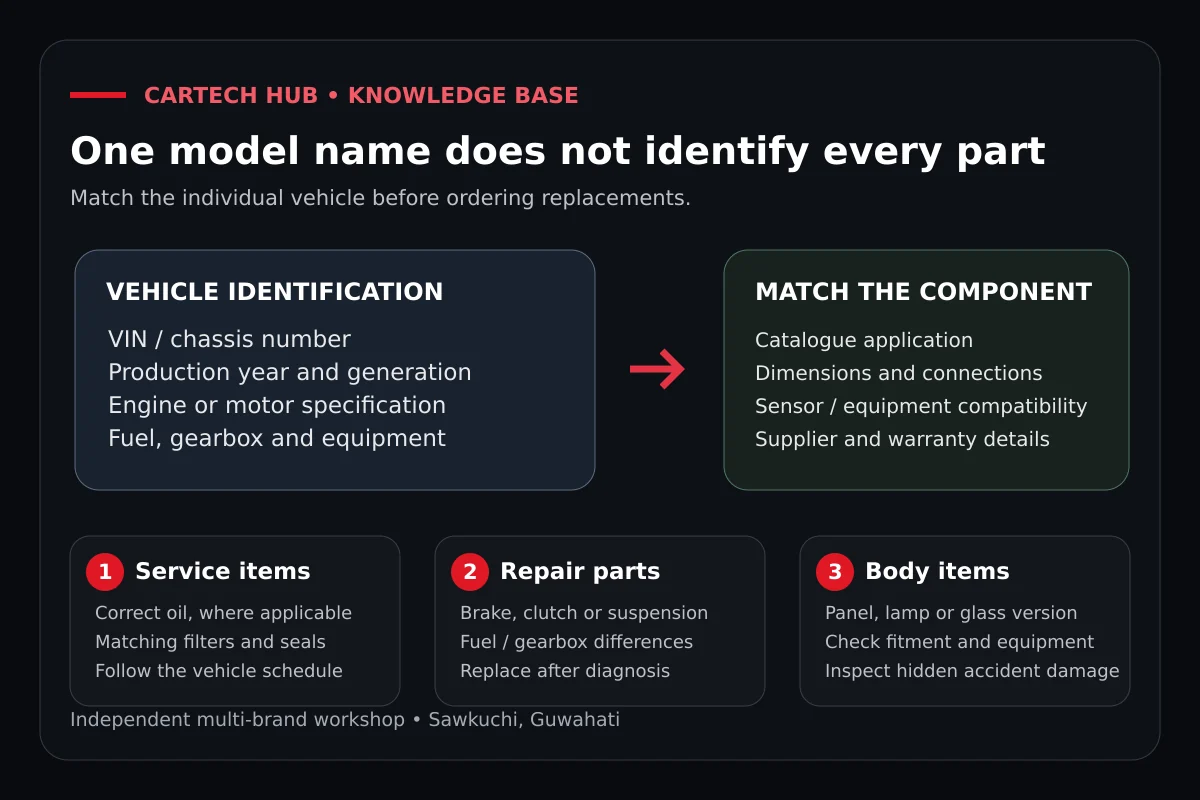
The proposed parts list should identify the vehicle year, trim and part numbers. Cabin filtration, brake components, bearings, suspension items and ordinary electrical replacements need compatibility checks. There is no petrol-engine oil service or conventional manual-clutch replacement in a Punch EV maintenance plan.
For accident work, relevant components can include front and rear bumpers, their brackets, bonnet, fenders, doors, mirrors, lamps, windshield, quarter panels and tailgate. A charging-area repair can also involve specific covers, fittings or electrical components; availability and safe testing must be confirmed by the responsible specialist. Do not substitute combustion-Punch parts solely because a panel appears similar in a photograph.
A damaged charging area needs a controlled inspection
If a collision involves the charging connector or nearby bodywork, avoid connecting a cable until competent assessment establishes that the condition is safe. CarTech Hub can document visible damage and coordinate the next inspection step in Guwahati. Any suspect high-voltage cable, battery enclosure or underbody injury calls for trained EV recovery and evaluation before energising the vehicle. An owner should not attempt isolation, dismantling or connector repairs.
Denting and painting follow the established repair assessment. Before refinishing, check mounting points, panel clearances, lighting and equipment that may need calibration. A neat paint finish does not demonstrate charging-system safety. Separate the cosmetic operations from electrical clearance so both are recorded in the handover information.
Prepare the insurance file before approving the job
Intimate the incident to the insurer through its recognised process and request the claim reference. Usual preparation includes the policy schedule, RC, driving licence, incident photographs, a completed claim form and any police or other report required for the circumstances. The insurer may ask for additional identification or supporting records. Keep the factual accident description consistent across those documents.
CarTech Hub's estimate can separate panel repair, replacement parts, paint work, labour and any specialist EV assessment. An insurer or surveyor may inspect before dismantling. Preserve damaged components until the claim instructions permit their disposal. Hidden damage should be supported with evidence and a supplementary estimate rather than added silently to the authorised job.
For example, owners holding ACKO or Go Digit policies should check their particular claims channels and workshop arrangements. Naming an insurer is informational and does not confirm a CarTech Hub network agreement. Third-party insurance alone does not pay for damage to the owner's Punch EV, and ordinary wear is not automatically accident damage.
Decide the payable scope before physical repair
A cashless request depends on the applicable own-damage cover, exclusions, insurer approval, inspection findings and workshop/network eligibility. Approval may cover some operations and exclude others. Obtain the owner's informed consent to the agreed scope as well as the insurer's authorisation, and identify any specialist work that the workshop cannot directly undertake.
Deductibles, depreciation, excluded consumables or other non-payable costs may remain with the customer. Zero-depreciation or EV-related add-ons apply only within their actual terms; they do not remove every charge. At completion, submit the final supporting documents through the correct settlement route, explain the customer balance and deliver with the repair record and any required EV safety or specialist documentation.
Plan the next step with CarTech Hub
Our Tata directory, electrical service guide and AC service information help define an enquiry. Compare the Tiago EV owner guide for a different city-car context, and read the Go Digit claim page for policy preparation.
Choose an online appointment or insurance claim enquiry. You can call CarTech Hub, send details on WhatsApp and open Google Reviews. Confirm the service capability before bringing the car. We provide independent multi-brand assistance in Guwahati and do not claim authorised Tata status.
Quick answers
Can I charge a Punch EV after damage near the charging connector?
Do not connect it while the condition is suspect. Arrange competent EV assessment and follow manufacturer recovery advice; an unbroken-looking cover does not establish electrical safety.
Are ordinary Punch parts suitable for a Punch EV repair?
Compatibility must be checked against the EV VIN, year and equipment. Similar appearance does not prove fitment, especially for charging-area components, thermal systems or electrical assemblies.
Will regenerative braking prevent brake wear checks?
No. The friction brakes, hydraulic system and wheel-speed sensing still need the checks specified for the vehicle. Diagnosis should distinguish normal regenerative behaviour from a fault.
Can an ACKO or Go Digit policy guarantee cashless repair here?
No. The actual policy, claim circumstances, insurer authorisation and current workshop or network arrangement must be confirmed. Non-payable amounts can remain the owner’s responsibility.