
In this guide
Check bonnet security after the Exter impact
A Hyundai Exter bonnet that sits high after an accident deserves more attention than a paint estimate. Do not repeatedly slam it to restore the gap. Record whether it latches securely, whether the front lamp has moved and whether surrounding parts touch. An insecure bonnet, loose lamp or other unsafe condition changes the transport plan; arrange appropriate recovery instead of driving to test it.
Start with a damage-inspection appointment at CarTech Hub, describing the bonnet and lamp symptoms. We are an independent multibrand workshop in Guwahati, not an authorised Hyundai service centre. Inspection support helps form the estimate, while IFFCO-TOKIO controls the policy and claim decision.
Check what your issued cover permits
IFFCO-TOKIO General Insurance Company Limited currently provides car insurance. Review the Exter's own-damage cover dates, vehicle details, deductible, exclusions and any relevant add-on wording. Third-party-only insurance does not fund repairs to your own Exter. Routine latch adjustment, faded paint or an old lamp fault is usually not an accident claim merely because another front component has been struck.
Identify the recent loss separately from earlier dents. If a headlamp was intermittently failing before the impact, disclose that history. The inspection may still find new accident-related damage, but the insurer needs an accurate account rather than a claim description that assigns every observed defect to one event.
Intimate the loss and gather the core records
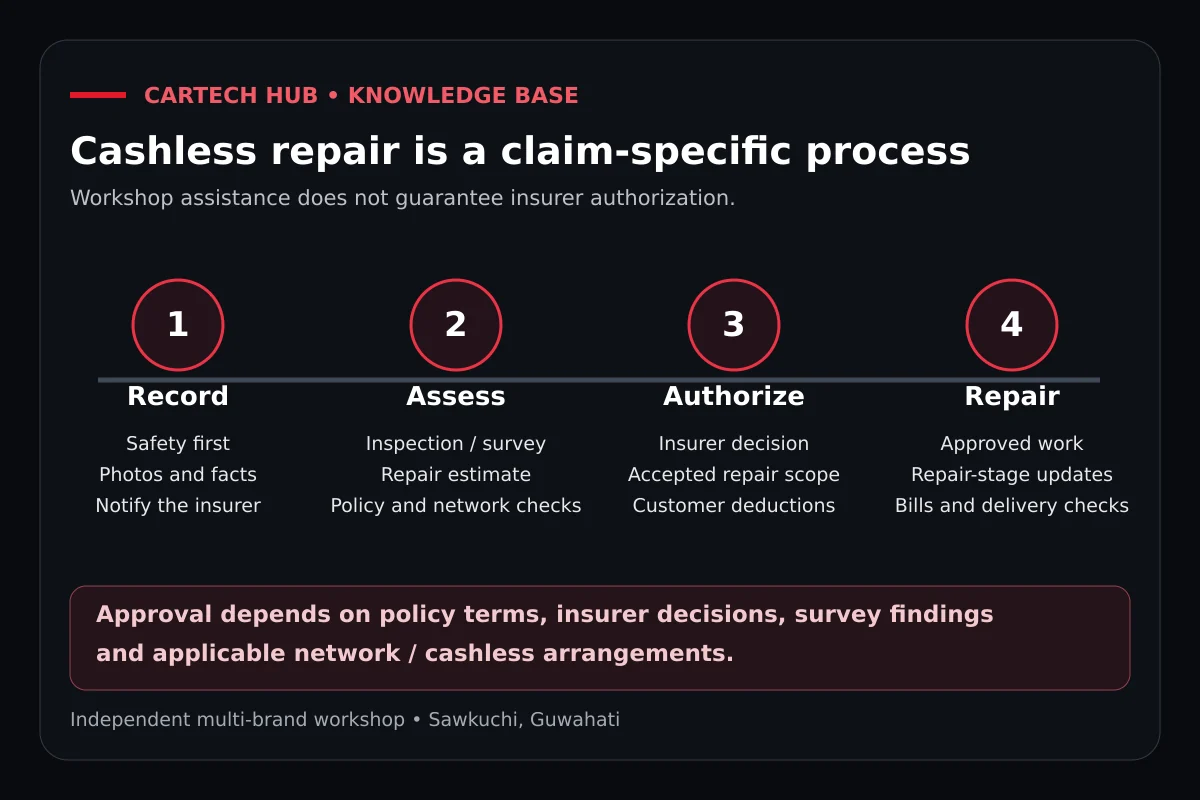
Contact IFFCO-TOKIO using the current official claim route or contact details in your policy. Keep the claim reference, acknowledgement and survey instructions. State the date, time, location and driver details, together with how the front contact occurred. Take a full front photograph and close-ups of the bonnet gap, lamp and visible damage where safe.
Prepare the policy copy, RC, valid driving licence, completed claim form, damage photographs and repair estimate. Provide an FIR or additional records only when required by the incident or the insurer's instructions. Keep any towing or protective-action documents for later review where applicable. Do not remove a damaged fitting simply to make the photographs look tidier.
Identify the Exter build and lamp arrangement
The VIN, manufacturing year and variant help identify the bonnet, latch, lamp and adjacent fittings. Hyundai publishes manuals by manufacturing period; use the one relevant to your Exter rather than assuming that current parts match every earlier build. Confirm the actual light functions, connectors and mounting points before selecting a replacement assembly.
The assessment should ask whether bonnet hinges or the surrounding front structure are affected, and whether lamp function and security can be restored through the proposed route. Structural, airbag or seat-belt concerns require qualified assessment and referral where appropriate. If fitted driver-assistance components are involved, establish their specialist requirements without presuming equipment or calibration capability from the model name.
Obtain approval for a reasoned repair estimate
Separate bonnet repair or replacement, latch-related findings, lamp damage, labour and paint in the estimate. Explain the repair choice with inspection evidence. A dent in the outer skin and a damaged latch support are different issues; accepting one should not leave the other hidden behind a broad line labelled front repair.
Await the insurer's instructed survey and approval before insured dismantling or work, unless IFFCO-TOKIO expressly permits earlier action. Ask what has been accepted, what remains provisional and how any protective work should be recorded. The workshop's proposed amount is not the insurer's payable amount, and owner consent is needed for work outside the accepted insured scope.
Keep hidden-damage additions reviewable
Authorised access may reveal a concealed lamp bracket or other damaged support. Preserve the finding, photograph it and submit a supplementary estimate with the additional parts and operations. Seek further insurer approval before carrying out extra insured repairs. Review any nonpayable amount with the owner before the expanded work is authorised.
If the new finding changes the technical route, pause to establish the appropriate qualified assessment. A bonnet that can be repainted may still have an unresolved closure issue. Confirm exact-part sourcing and work planning after identification and approvals; the initial enquiry does not promise that a specific assembly is stocked or that the job will finish within a fixed interval.
Assess the completed repair before collection
After approved repair or replacement and painting, check bonnet opening, secure closure, relevant lamp operation and panel fit. Discuss any remaining unusual resistance, vibration or warning. Appropriate functional checks should address the symptoms recorded at intake, while specialist records are required where relevant to fitted systems or the accepted repair route.
Compare the final invoice with the original and supplementary approvals. Retain invoices, receipts and any final documents requested by IFFCO-TOKIO. Clarify deductible, depreciation, excluded consumables and customer-approved extras. Cashless depends on the policy, insurer approval, survey and workshop network eligibility; CarTech Hub's IFFCO-TOKIO cashless arrangement is confirmed, subject to the insurer's decision on this claim. Use cashless claim assistance to confirm eligibility, then agree payment and insurer release requirements before delivery.
Plan an Exter claim-assistance appointment
Read the IFFCO-TOKIO authorisation guide and insurance claim hub to prepare questions. The Exter service, parts and insurance article and Hyundai care information cover broader enquiries.
Call CarTech Hub or send bonnet and lamp details on WhatsApp, including the manufacturing year and whether the car is safely movable. Read Hyundai owner reviews before arranging the inspection. Claim approval and cashless confirmation remain case-specific insurer decisions.
Quick answers
Can a bonnet be considered repaired if only its visible dent has disappeared?
Appearance is one part of the review. The closure, latch-related findings and relevant fit must also be assessed against the authorised repair scope.
Should I open a stiff bonnet before the survey?
Avoid forcing it. Report the resistance and follow the workshop and insurer instructions for safe assessment and evidence preservation.
Does a working bulb mean an accident-damaged lamp assembly can stay?
A functioning light does not establish that the housing, mounting or sealing is sound. The actual condition determines the repair proposal and insurer assessment.
Why should the estimate distinguish left and right lamp damage?
It prevents ambiguous part identification and helps the surveyor match each proposed operation to photographs. The undamaged side should not be included merely for symmetry.