
In this guide
An older Endeavour often has an ownership history stretching across several drivers and workshops. Before an owner in Guwahati orders a clutch, authorises an engine repair or hands over an accident claim, it helps to reconstruct that history. CarTech Hub provides independent multi-brand service and repair planning, including Ford accident assessment and insurance documentation assistance. The aim is to understand the vehicle in front of the workshop, rather than assume it shares the mechanical details of a later Endeavour.
Identify the older Endeavour before quoting parts
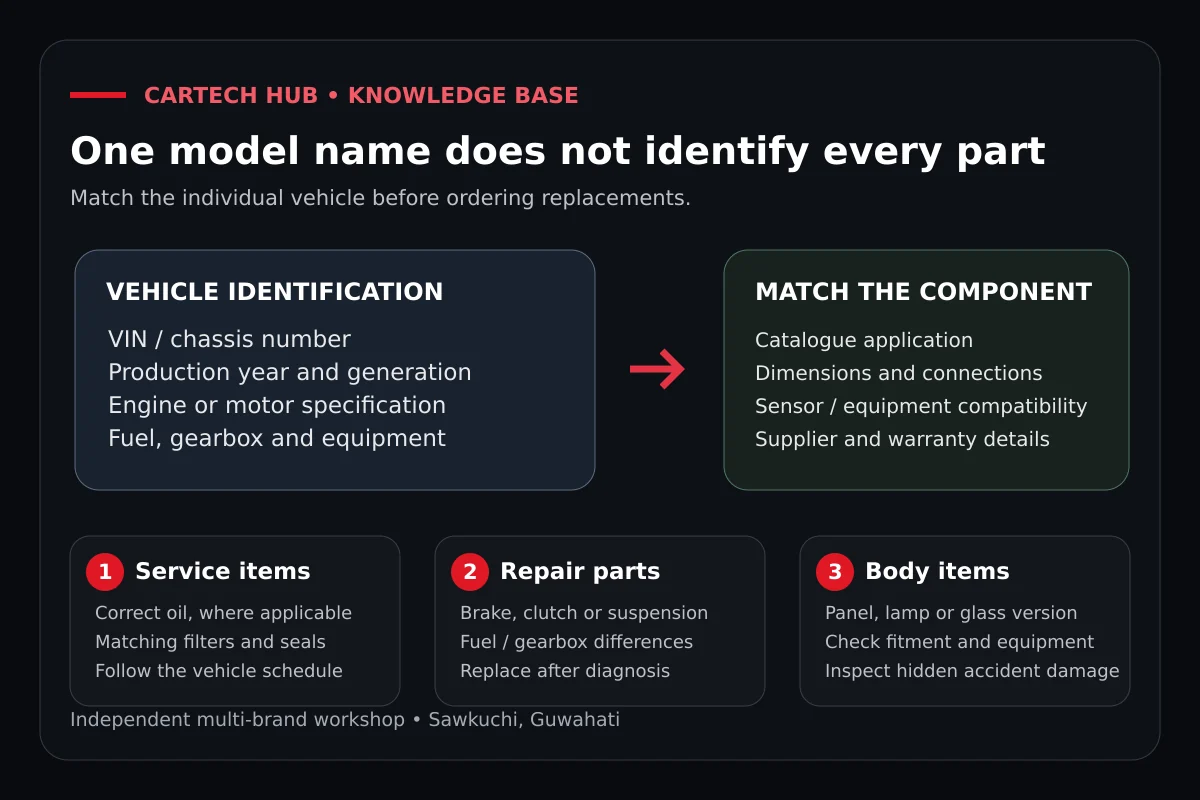
Ford India's older maintenance information distinguishes a 2.5 diesel manual 4x2 from a 3.0 diesel automatic 4x4. These are useful identification examples, not a complete description of every vehicle carrying the badge. Confirm the VIN, engine, transmission, drive configuration and any previous modifications. A registration year by itself can be misleading when a vehicle has spent time in storage or changed ownership.
Separate rear-drive work from four-wheel-drive work
A rear-wheel-drive example has a different driveline inspection requirement from a fitted four-wheel-drive vehicle. The propeller shaft, joints, axle condition and mounts deserve attention when symptoms point there. Front drive components and transfer-system work should only enter the estimate where fitted. A generic front-wheel-drive hatchback CV-joint checklist is an unsuitable shortcut for this SUV.
Re-establish a sensible maintenance baseline
Bring the owner's manual, old invoices and a record of fluids already used to a general service inspection. Time limits still matter when yearly mileage is low. Repeated idling, dusty travel, carrying loads and long storage can change what needs closer examination; they do not justify inventing a universal shorter replacement interval.
The diesel engine requires suitable oil and an oil filter, with air and fuel filtration checked for the particular engine. Assess the filter housing, fuel supply and evidence of contamination before blaming injectors. Applicable glow-system checks concern cold-start behaviour; a diesel does not receive petrol spark plugs or ignition coils. Cabin filtration is included only if the actual HVAC installation uses a serviceable filter.
A changed temperature indication, coolant loss or a belt noise calls for inspection of the radiator, fan, hoses, water pump, thermostat and fitted belt system. Record leaks and previous repair evidence. Opening a hot cooling system or probing fuel injection equipment is not a customer troubleshooting task.
Investigate engine and transmission symptoms together
A loss of pulling power could involve air restriction, fuelling, turbocharger plumbing, sensors or engine condition. The engine diagnosis service should distinguish a measured finding from a guess based on exhaust smoke. Turbocharger replacement is not justified solely by a whistle; specialist testing or referral may be necessary after the preliminary inspection.
On a manual vehicle, clutch slip, release behaviour and difficult selection can direct checks of the clutch plate, pressure plate, release bearing, actuation and relevant flywheel components. An automatic requires its own fault, fluid-condition and operating assessment. Do not buy a manual clutch kit for an automatic or approve a universal transmission fluid. Gearbox mounts, seals and the remaining driveline enter the repair plan according to confirmed fitment and findings.
Give braking, steering and the frame proper attention
An older SUV needs checks beyond a paint inspection. Examine its frame/body mounting areas, corrosion, earlier welding and accident history before deciding that the vehicle is ready for more long-distance travel. Structural or restraint work requires the correct equipment, procedures and capability; CarTech Hub should confirm what can be undertaken and when a qualified specialist is needed.
Brake assessment covers fitted pads, discs, rear brake assemblies, calipers, hydraulic components and fluid. ABS sensors and wiring are considered where equipped. Suspension and steering checks can include bushes, arms, joints, shock absorbers, wheel bearings and applicable rear suspension components. Parts should be selected from the chassis specification, not a listing that merely says “Endeavour.”
AC weakness requires checks of airflow, the fitted compressor, condenser and evaporator circuit before a refrigerant service. Battery condition, alternator output, starter operation, grounds, relays and wiring merit testing when starting or charging is unreliable. Available electronic scanning supports the diagnosis; it cannot eliminate the need for physical inspection on an ageing vehicle.
Make an older-body repair estimate realistic
After an impact, document the bonnet, fender, doors, quarter areas, tailgate, bumpers and their brackets as the damage requires. Headlights, tail lights, ORVMs, grille, glass and radiator support may need fitment checks before procurement. Confirm availability, condition and a realistic sourcing route without promising that an old panel is on the shelf.
Denting and painting follows the agreed repair method. Separate accident damage from existing corrosion and previous poor repairs. Discuss whether a panel can safely be repaired, whether replacement is necessary and what consequential work needs an estimate. A shiny repaired bumper is not proof that chassis alignment or steering safety has been restored.
Handle the insurance decision before dismantling
Insurance Claim Assistance Available – Cashless Eligibility to Be Confirmed
For an older Ford Endeavour accident in Guwahati, start by contacting CarTech Hub with vehicle and policy details. Safely record the accident damage and intimate the claim to the insurer. The requested papers commonly include the policy, registration certificate, driver's relevant licence, claim form and photographs; an FIR or other report is provided when the insurer or circumstances require it.
National Insurance or New India Assurance instructions, for example, must be checked against the actual policy. Arrange the required survey before dismantling affects the evidence. Submit an itemised estimate, including relevant sourcing information for older components. Hidden damage discovered later needs a supplementary submission and a further decision where required. Insurer approval does not replace your consent to the workshop's repair scope.
Cashless repair is conditional on policy cover, survey findings, insurer authorisation and applicable workshop/network eligibility. No universal Ford or insurer affiliation is implied. Third-party-only cover does not pay to repair your own SUV. Ageing parts, routine wear and unrelated corrosion cannot simply be included as covered accident damage.
Once the approved work is complete, settle final documentation and the owner's share before delivery. Deductibles, applicable depreciation, excluded items and unapproved maintenance may remain payable. The insurer determines admissibility and any total-loss assessment; the workshop cannot promise that an expensive old-vehicle repair will be authorised. Agree the delivery checks and retain the invoice and claim correspondence.
Bring the history to your Guwahati appointment
Book an older Endeavour inspection with the VIN and service history. For collision work, request claim assistance before approving repairs. Call the workshop to discuss whether recovery is safer than driving, or WhatsApp the visible damage. Use the Google Reviews link when checking workshop information, and the Ford care directory for more guidance. Specialist scope, parts availability and claim arrangements must be confirmed for your actual vehicle.
Quick answers
Does an older Endeavour automatically need four-wheel-drive servicing?
No. Establish the drive configuration first. Transfer-system and front-drive work only apply where the relevant equipment is fitted; a 4x2 needs its own rear-driveline checks.
Can a later Endeavour rotor or radiator be fitted to my older SUV?
A shared model name is insufficient. The VIN, engine, chassis and actual part specification must be matched before choosing a replacement.
Will the insurer pay to remove rust revealed during accident repairs?
Existing deterioration is different from the insured accident. It should be recorded and separated in the estimate; the insurer decides what the policy admits.
What should I bring if the Endeavour has changed owners several times?
Bring the RC, VIN details, current policy, correct manual if available and any earlier repair invoices. Point out known modifications and past accident work so the inspection can address them.