
In this guide
A later Ford Endeavour can be a family vehicle, a highway traveller and a city commuter on the same day. That mixed use does not mean every example needs the same service package. At CarTech Hub in Guwahati, a useful Ford Endeavour repair conversation starts with the precise vehicle, the owner's symptoms and the work already carried out. Mechanical maintenance and accident claim work can be coordinated, while their costs and approvals remain clearly identified.
Decode the later Endeavour specification
The Indian range changed during its life. Ford's 2019 information identifies 2.2 diesel manual and automatic variants, alongside a 3.2 diesel automatic; later official material describes the 2.0 EcoBlue diesel with a ten-speed automatic. Earlier later-generation configurations and drive options need their own confirmation. Record the build information, engine, gearbox and 4x2 or 4x4 specification rather than rely on trim badges alone.
A gearbox complaint is not a generic clutch job
A manual gearbox has clutch and release components that differ from the work required on an automatic. Even automatic versions do not all share an identical transmission, fluid requirement or procedure. A delayed engagement, warning or vibration should be documented before a transmission diagnosis; internal repairs, programming or specialist work must be confirmed within the workshop's actual capability.
Keep maintenance tied to the correct manual
Use the owner's service schedule for the actual engine and transmission. Bring invoices showing oil, coolant and previous filter replacements. Distance and elapsed time both matter, and frequent low-speed journeys in Guwahati may require discussion of the manual's operating-condition guidance. A blanket interval copied from another Endeavour is not a sound starting point.
Engine oil and the oil filter must have the correct specification. Air filters, diesel fuel filtration, relevant belts, seals and engine mounts enter the inspection according to schedule or findings. Petrol spark plugs and ignition coils do not belong on a diesel Endeavour checklist. Applicable glow components are considered when diagnosis supports them. Where the variant has particular exhaust after-treatment equipment, follow its own warnings and instructions instead of assuming all generations share the same system.
Find the cause of a diesel or cooling complaint
Describe when a hesitation or loss of power occurs, whether there is a warning and whether it followed refuelling or a recent repair. Electronic fault information, live data and physical checks help separate sensor, air-path, fuel-system, injector and engine concerns. Turbocharger-related hoses, connections and control components deserve assessment before condemning the turbocharger itself.
The engine service inspection also considers leaks, mounts and cooling condition. A radiator, thermostat, water pump, cooling fan or hose may be relevant to overheating, but none should be replaced simply because its name appears on a parts list. Diesel fuel-system and emissions procedures can require specialist equipment; do not attempt home dismantling or bypass a warning system.
Check the running gear as an assembled vehicle
On a fitted four-wheel-drive Endeavour, front drive components, transfer operation and the rest of the driveline require the relevant variant guidance. A 4x2 does not receive the same transfer-system job merely because another vehicle has it. Propeller-shaft joints, drivetrain mounts and axle-related components are investigated where the complaint points to them.
Brakes are assessed for fitted pad and disc condition, caliper function, hydraulic integrity, fluid and electronic ABS information. Wheel bearings, suspension arms, ball joints, bushes, stabilizer links, dampers and steering components are considered as fitted. Wheel alignment follows correction of damaged or loose parts; it cannot remedy a worn joint or accident-deformed mounting point.
AC comfort depends on more than refrigerant quantity. Check cabin airflow and applicable filtration, blower operation and the compressor, condenser and evaporator circuit. Weak starting deserves a battery test, charging-system checks and starter assessment, with wiring, relays and grounds examined as necessary. ECU and ABS scanning support these decisions rather than prescribe an expensive assembly automatically.
Put suitable parts into a transparent estimate
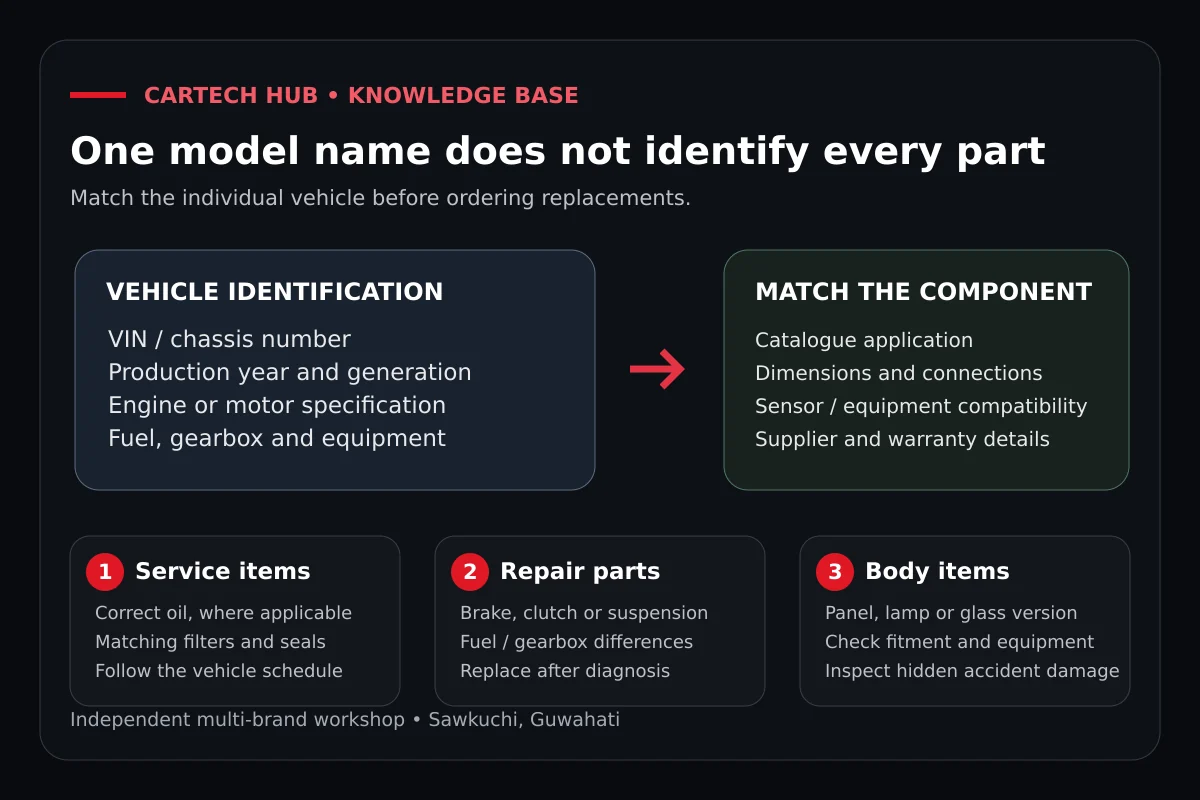
Order service and repair parts by VIN and application, with any superseded number or fitment uncertainty resolved before work. Separate consumables, diagnosed replacements and optional maintenance. Gearbox mounts, transmission seals and relevant driveline components should be identified specifically; a generic manual clutch assembly should not be added to an automatic quote.
For accident work, inspect bumpers and their brackets, grille, bonnet, fenders, doors, quarter panels and tailgate according to the impact. Headlights, tail lights, ORVMs, windshield and other glass require the proper variant and mounting checks. A frontal impact can also disturb the radiator support, condenser or cooling system. Confirm sourcing and the proposed repair method without guaranteeing immediate stock.
Coordinate body repairs with the claim evidence
CarTech Hub's accident repair assessment records visible damage and areas needing further investigation. A body-on-frame SUV with a wheel or underbody impact may need chassis, alignment, suspension and restraint checks beyond panel refinishing. Safety-related structural work must follow suitable procedures, with specialist referral where the workshop's equipment or scope requires it.
Denting and painting comes after a sound decision about repair versus replacement. Agree paint boundaries, colour matching, corrosion protection and final panel fit. Insurer inspection may be needed before dismantling; preserving evidence helps distinguish insured accident damage from pre-existing defects or routine maintenance.
Manage cashless eligibility and the owner's share
Insurance Claim Assistance Available – Cashless Eligibility to Be Confirmed
For Ford Endeavour insurance claim assistance in Guwahati, first send CarTech Hub the vehicle identity, accident account and policy details. Intimate the claim to the insurer and assemble the requested policy copy, RC, driver's licence, claim form and photographs. Provide a police report or additional documents where required by the event or insurer.
A Tata AIG or ICICI Lombard policy, for instance, is assessed on its own terms, not on the size of the repair estimate. The workshop prepares an itemised estimate for the insurer and arranges survey coordination where needed. Newly uncovered damage requires a supplementary estimate and the relevant authorisation. Obtain both insurer approval where applicable and your own consent to the work before approved repairs proceed.
Cashless availability depends on own-damage cover, survey findings, insurer approval and current workshop/network eligibility. CarTech Hub does not claim a tie-up with every insurer or authorised Ford status. Third-party-only cover does not fund your own accident damage. Ordinary wear or an unrelated gearbox complaint is not automatically part of a collision claim.
After repairs, submit final documentation and reconcile approved amounts, deductibles, depreciation and excluded charges. A zero-depreciation add-on may have conditions and does not remove every customer payment. Arrange delivery only after the work and necessary safety checks are complete, keeping the invoice and any agreed follow-up advice.
Start with vehicle details, not an assumed package
Reserve an Endeavour service appointment for maintenance or symptoms, or open an insurance repair enquiry after an accident. Call +91 98647 70033 to discuss safe transport, and WhatsApp the VIN and relevant photographs. The workshop reviews link and Ford guide hub help you explore CarTech Hub's independent multi-brand support in Guwahati, Assam.
Quick answers
Can the ten-speed Endeavour use the same transmission service as an earlier automatic?
Do not assume that. Identify the actual gearbox and consult its specification and procedure before approving fluid or internal work.
Does every later Endeavour need transfer-case inspection as a 4x4?
No. Drive configuration differs by variant. Inspect four-wheel-drive equipment only where fitted and use the appropriate driveline guidance.
Why inspect the cooling pack after a seemingly minor front impact?
A bumper mark may conceal displaced brackets or damage around the condenser, radiator and support. The extent needs inspection rather than a decision from appearance alone.
Will zero-depreciation insurance cover my entire Endeavour repair bill?
Not necessarily. Deductibles, excluded work, limits and other policy conditions can still affect the owner’s payment. Confirm the authorised settlement and workshop eligibility before relying on cashless repair.