
In this guide
Tata introduced the Xenon XT as a four-door, five-seat lifestyle pickup, including sales through its passenger-car dealerships. That history does not prove that every individual example has private registration or the same insurance category. At CarTech Hub in Guwahati, a Xenon XT service or accident enquiry should begin with the actual RC, variant and operating use, followed by confirmation of repair capability and model-specific parts availability.
Distinguish the XT from other Tata pickups
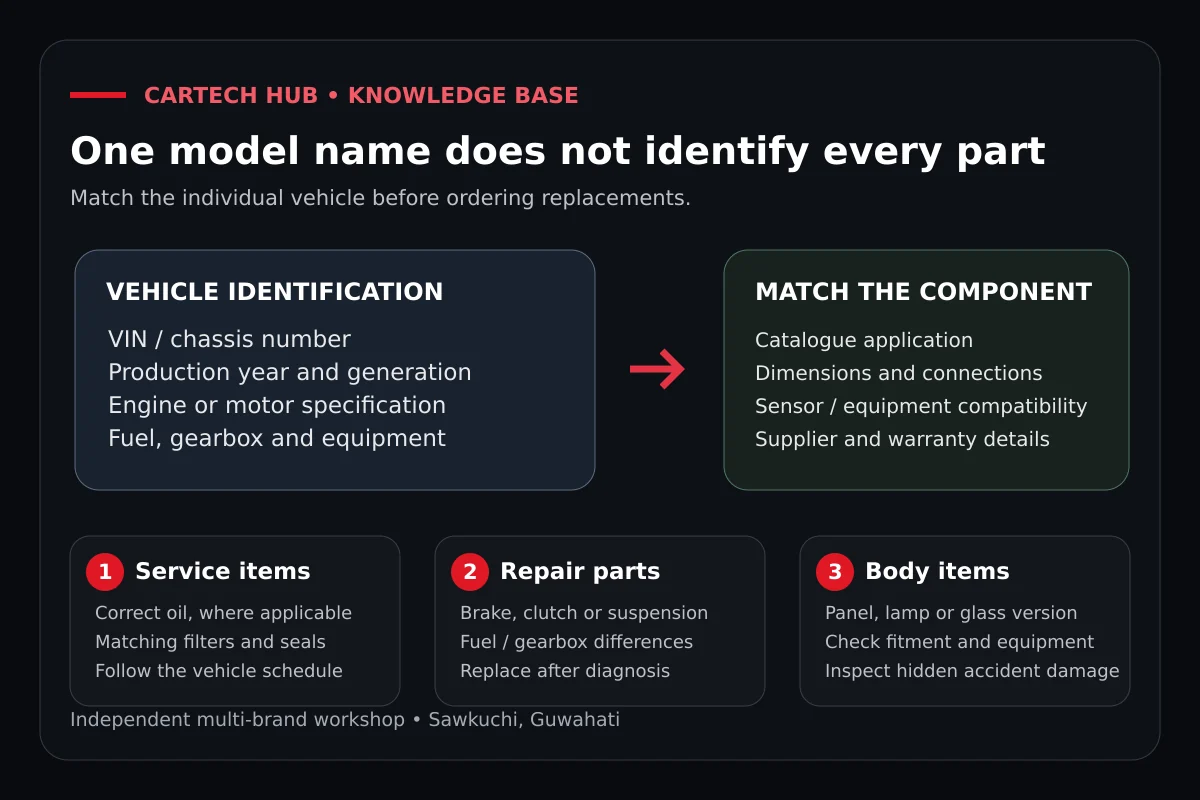
Provide the chassis number, engine and transmission details, manufacturing information and photographs where relevant. The Xenon XT must not be treated as interchangeable with every later Xenon or a Yodha commercial variant. Confirm the two-wheel-drive or four-wheel-drive equipment actually installed rather than inferring it from a pickup body or accessories.
Tell the workshop about added canopies, lights, tyres or other changes. Explain whether the vehicle is used personally or for another purpose, and share the relevant service records. Registration category and permitted use belong in the file alongside mechanical history; a showroom's historical sales channel is insufficient evidence for present-day insurance eligibility.
Follow the correct diesel maintenance instructions
Scheduled work should use the appropriate manufacturer's guidance for the actual vehicle. Discuss specified engine oil, oil filter, air filtration and fuel-filter requirements, together with belts, cooling hoses and fluid checks. Diesel injection components and any glow-plug equipment require their own applicability checks. A petrol spark-plug set is not a normal diesel maintenance item.
Record conditions rather than guessing a failure
Explain starting behaviour, temperature changes, warning indications or loss of performance, including whether the concern appears after storage or under particular operating conditions. Engine mounts, injectors, sensors, radiator components, cooling fans and hoses are possible assessment areas, not a predetermined replacement bundle. Specialist fuel-system or engine work needs an appropriate diagnostic basis and confirmed resources.
Guwahati traffic and journeys into nearby districts provide useful usage context. Loading should follow the limits and instructions for the vehicle, not a generic pickup assumption. Tyre information must match the actual vehicle and permitted load. This guide specifies no universal pressure, oil grade or service interval.
Identify the transmission and driven components
For the fitted manual drivetrain, clutch engagement, release operation, gear selection and mounting condition should be examined together. Confirm clutch plate, pressure plate, release bearing and other related fitment before ordering. A shift concern should be described by gear, temperature and operating circumstance rather than diagnosed from the badge.
Axle and propeller-shaft components, along with any four-wheel-drive system fitted, need the right procedures. Recovery after an impact may require instructions appropriate to the actual driveline. CarTech Hub should confirm specialised drivetrain capability and refer work where necessary. No claim is made that every transfer component or axle can be rebuilt at the workshop.
Brakes, suspension and comfort deserve their own estimate lines
Inspect the actual brake friction components, hydraulic system and any ABS equipment present. Match pads, discs or drums to the fitted assembly rather than copying a different Tata pickup's list. Suspension layout, dampers, joints, bushes, steering parts and wheel bearings require verified applicability and condition checks. Changes made for carrying or appearance should be disclosed during assessment.
AC diagnosis should separate restricted airflow, compressor or condenser concerns and control faults. Check cabin filtration where fitted. The low-voltage battery, alternator, starter, wiring, lamp circuits, fuses and relays may need assessment according to symptoms. Accessories should retain safe circuit protection; an electrical modification should not be hidden merely because it was fitted by a previous owner.
Pickup-body damage extends beyond the cab panel
A Xenon XT estimate may involve front bumper, bonnet, fenders, cab doors, lamps, ORVMs, windshield, load-bed sides, tailgate and supporting components. Rear-impact inspection should consider bed mountings, closure hardware and nearby chassis or axle concerns where indicated. The body and fittings must be identified before asking a supplier for a generic “Xenon bumper.”
Denting and painting should follow repairability and alignment assessment. A damaged bed accessory or goods carried in the vehicle is not automatically treated as an insured vehicle component. Structural, restraint or chassis-related damage requires qualified evaluation and referral where appropriate. Older XT panels and trim need confirmed sourcing; this article does not promise ready stock or an unrestricted restoration service.
Insurance and cashless repair: policy category comes first
CarTech Hub assists with accepted Tata accident repairs, damage records and insurance documentation in Guwahati. Cashless repair depends on insurer approval, policy conditions, survey findings and workshop/network eligibility. Check that the policy suits the RC, permitted use and actual incident. Third-party-only insurance does not pay for repairing the owner's pickup; service wear and unrelated earlier damage are not automatically accident losses.
Intimate the claim through the insurer's prescribed contact route. Retain photographs and an accurate description of the event and vehicle use. Requested records can include policy details, RC, driving licence, claim form, incident reports and further classification- or use-related information where applicable. Ask about inspection and survey before dismantling changes the damage evidence.
The estimate should distinguish cab or load-bed repair, replacement parts, paint, labour and any mechanical diagnosis. It should disclose accessories and pre-existing concerns separately. Hidden findings or uncertain parts supply may require supplementary estimates and sanction. The insurer decides claim admissibility and payable scope; the owner independently consents to the proposed workshop work and uncovered costs.
Deductibles, depreciation, exclusions and non-payable amounts must be reviewed against the actual cover. Do not assume a private-car add-on applies to another vehicle classification or that all carried goods are covered. Final invoices and approved revisions should match the work completed. Agree on delivery checks for brakes, steering, cooling, lights, cab closure, bed/tailgate operation and unresolved driveline issues.
Arrange an XT-specific conversation
Browse the Tata model hub, gearbox-service page, steering information and body-repair guide. The Hexa article illustrates why drivetrain identity also matters on a different Tata vehicle. Zurich Kotak guidance and HDFC ERGO information provide policy enquiry routes without guaranteeing a workshop network arrangement.
Book online, send a claim enquiry, call +91 98647 70033 or WhatsApp the vehicle details. Find feedback information through the Google profile/reviews route. CarTech Hub is an independent multi-brand workshop in Guwahati and does not claim Tata-authorised status; XT work and parts availability require prior confirmation.
Quick answers
Does the Xenon XT’s passenger-dealer history prove private insurance applies?
No. The individual vehicle’s RC, permitted use, policy category and incident circumstances must be checked.
Can a Yodha part be ordered for an XT without checking fitment?
No. Different pickup families and production details require verified component identification. Similar appearance is insufficient.
Does a damaged load bed mean goods carried in it are insured too?
Not automatically. Vehicle damage, accessories and goods can have different coverage requirements; ask the insurer about the actual policy.
How should four-wheel-drive damage be assessed after an impact?
Confirm the fitted system and appropriate recovery or diagnostic procedures. Specialised work may need qualified referral before a repair scope is accepted.