In this guide
Keep the charging concern specific
A Kona Electric that behaves differently at a home AC charger and a public DC charger needs a useful account of both events. Note the state of charge, any vehicle message, the charger used and whether the session ever began. A failed charging attempt does not identify which side of the connection caused the problem. These observations help prepare an informed assessment in Guwahati.
Kona Electric is absent from Hyundai’s October 2026 India sales menu and is classified here as a legacy India EV. Hyundai retains its owner manual online. Current overseas Kona vehicles should not be assumed to share an older India car’s battery, charging hardware or body fittings.
Identify the electric vehicle for every parts request
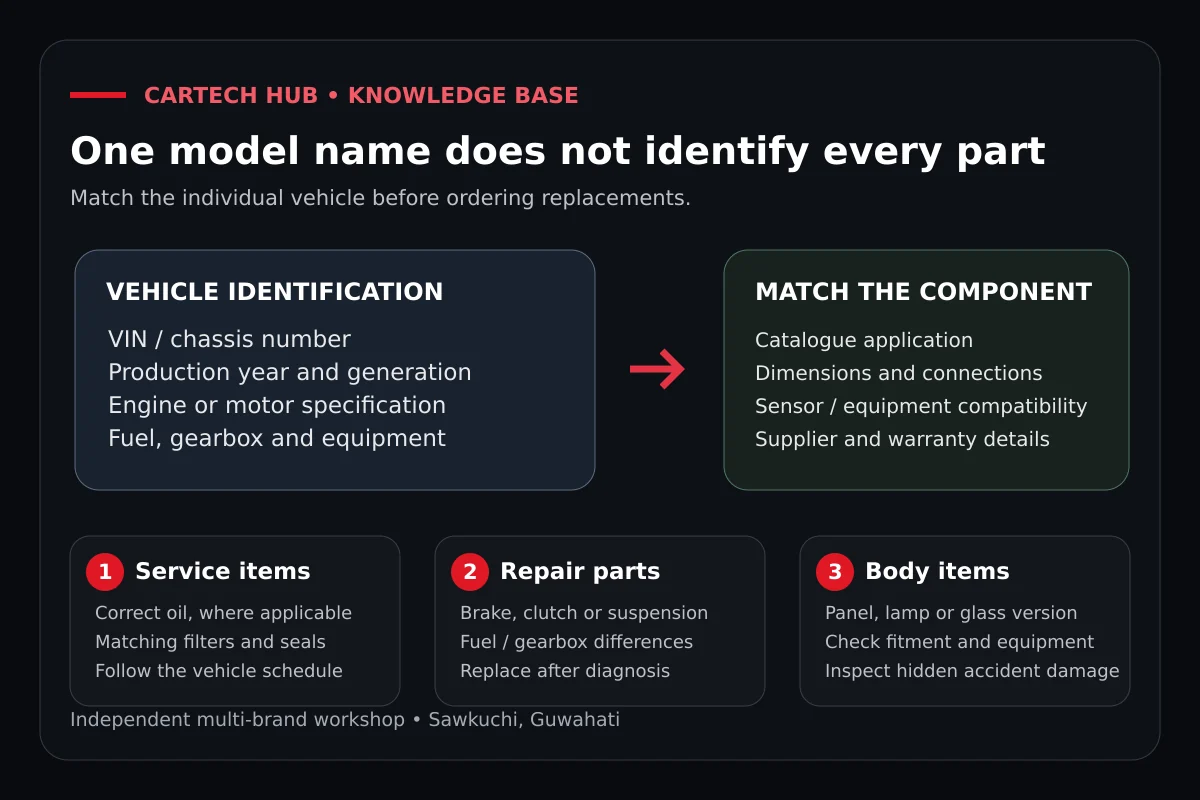
Record the VIN, manufacturing year, electric powertrain, battery version, motor and reduction-drive specification, plus trim and market details. Confirm the actual fitted specification rather than choosing a battery capacity from a manual that includes optional regional versions. Brakes, suspension, lamps, charge-port fittings and cooling components still need vehicle-specific part-number checks.
Ask which compatible part is proposed, whether the complete assembly or only a fitting is needed, and what warranty applies. Supplier availability should be confirmed before a completion date is set. A body item that looks similar on a newer Kona may have different mounts or connectors.
Separate 12V power from the traction battery
The Kona Electric has a low-voltage 12V battery as well as a high-voltage traction battery. A flat 12V battery can affect access, control systems and the ability to make the vehicle ready; it does not establish that the traction battery requires replacement. Inspect the low-voltage battery, relevant connections and reported fault information through the appropriate procedure.
If a Kona warning points towards the traction battery or electrical isolation, establish a qualified EV referral route before deciding what to replace. Follow Hyundai’s OEM diagnostic and safety procedures; a manufacturer warranty enquiry belongs with the appropriate Hyundai channel. CarTech Hub can discuss the inspection request as an independent multi-brand Guwahati workshop, not an authorised Hyundai workshop. No in-house high-voltage battery repair capability is claimed.
An EV maintenance visit still has a clear inspection list
Use the correct owner manual, time, mileage and operating conditions to plan brake fluid, cabin-filter, cooling-system and reduction-drive checks or service as specified. Examine tyres, wheel damage, steering joints, suspension bushes, dampers and drive-shaft boots. Record leaks and damaged fittings rather than applying a combustion-car checklist.
Regenerative braking does not remove the need to inspect pads, discs, caliper movement, hoses and parking-brake operation. Explain any noise, pull or changed pedal feel promptly. Brake inspection enquiries can be combined with tyre and suspension assessment when wear or an impact makes that appropriate.
Investigate charging and thermal management safely
Check visible charge-port condition, cable damage, connector seating and the relevant warnings without inserting tools or touching electrical contacts. A recurring concern needs qualified checks to distinguish charger-supply problems from the vehicle’s systems. Charging performance also depends on conditions, so a brochure charging time is not a repair acceptance standard.
Cooling circuits and cabin AC need correct EV-specific fluids and procedures. Report coolant loss, warning messages or weak cabin airflow. Do not open orange high-voltage cables, connectors or traction-battery covers. Qualified EV specialists should assess high-voltage or thermal-system concerns and follow Hyundai’s procedures, including referral through the appropriate channel when necessary.
A low impact can affect more than the bumper
After a kerb or underbody strike, do not judge the car’s safety solely from an intact bumper. Photograph visible damage and report the impact location. Underfloor battery protection, suspension and nearby cooling or electrical components may require specialist assessment. Avoid restarting or charging a vehicle with relevant warnings, visible battery-area damage or signs of a serious electrical problem until qualified guidance is obtained.
Panel, lamp and bumper work must preserve the correct mounting and clearances. Structural areas, airbags and restraint systems need capability confirmation and referral where needed. Any fitted driver assistance equipment should follow its applicable inspection and calibration requirements.
Document the EV accident before agreeing the claim scope
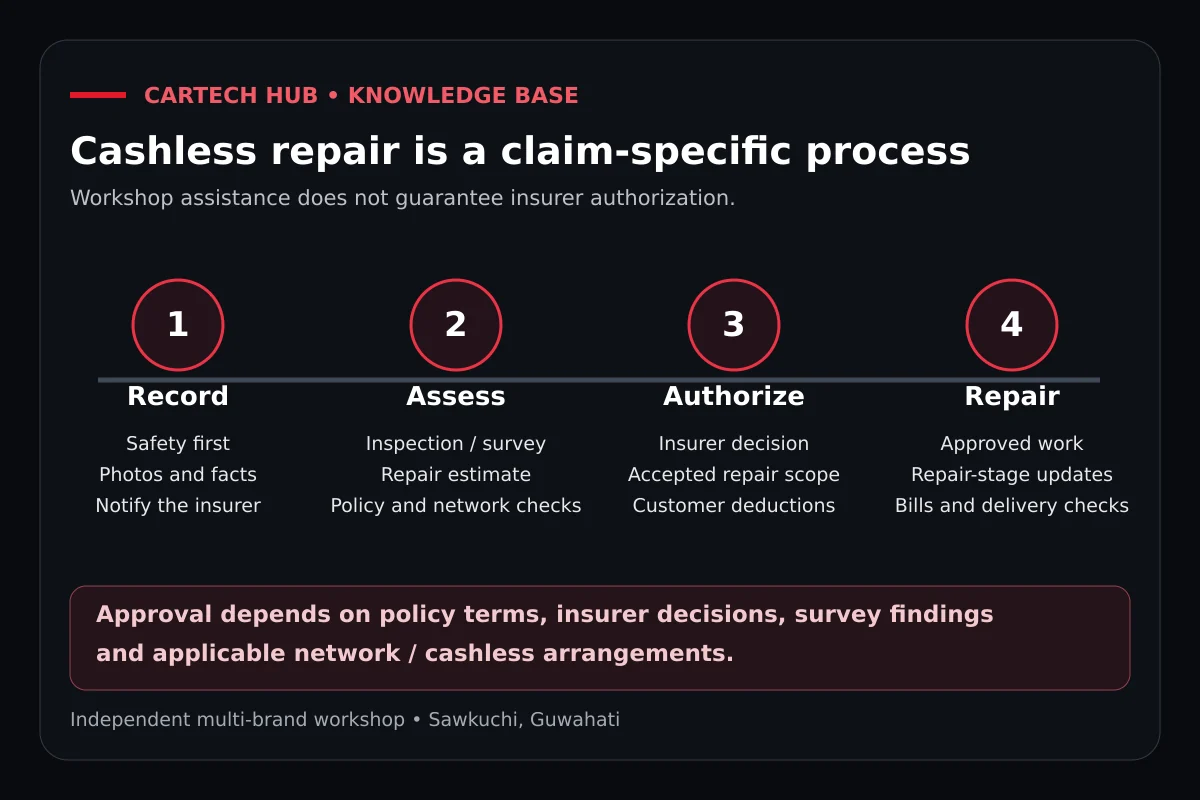
A charge-port impact and a charging failure without an accident are different insurance questions. Give ACKO, Zuno or your actual insurer the factual event account through its instructed reporting route. Keep the policy schedule, RC and driver’s licence with original damage photographs and the requested claim form; obtain an FIR or other police record only if the incident requires it. Check the relevant EV cover instead of assuming every electrical fault is insured. Third-party-only protection does not pay for your own Kona Electric’s damage, and ordinary wear is normally outside an accident claim.
Arrange the required survey and obtain approval before insured dismantling or repair, unless the insurer expressly permits otherwise. Qualified EV safety assessment and insurer repair approval serve different purposes. Submit an itemised estimate, agree approved repairs and refer specialist work appropriately. Seek approval for additional damage, record quality checks and explain deductibles, depreciation, exclusions and non-payable costs before delivery. Cashless eligibility depends on insurer, policy, survey and workshop-network arrangements; no insurer tie-up is claimed.
Share the vehicle details before arranging attendance
Explore the Hyundai guide hub and Creta Electric guide. Book an EV inspection enquiry, request claim assistance, call 9864770033 or WhatsApp CarTech Hub. Check Hyundai reviews and directions and electrical assessment information; describe any impact or high-voltage warning before moving the vehicle.
Quick answers
Does a flat Kona Electric 12V battery mean the traction battery has failed?
No. The 12V and high-voltage batteries have different roles. Appropriate low-voltage testing and fault assessment should establish the concern before a traction-battery diagnosis is proposed.
What should I record when Kona Electric charging fails at one location?
Record the charger type, session behaviour, state of charge, messages and whether charging works elsewhere. Share that evidence for qualified assessment; it does not justify probing the charge-port contacts yourself.
Can a Kona Electric underbody strike be treated as a cosmetic bumper repair?
The impact location may require qualified EV inspection of underfloor protection and adjoining systems. Confirm the safe assessment route before charging or driving when warnings or battery-area damage are present.
Will CarTech Hub open my Kona Electric traction battery for a claim?
No in-house high-voltage repair capability is claimed here. Qualified EV assessment, Hyundai procedures and appropriate referral must be established; insurer approval is also required for insured dismantling unless expressly permitted otherwise.