In this guide
A change in braking deserves a different response from an ordinary comfort complaint. If a Maruti Suzuki takes longer to stop, has an unusually soft pedal or behaves unpredictably under braking, do not wait for a routine service slot to investigate it. Stop safely and obtain guidance about recovery when braking performance may be compromised. A workshop inspection should establish the condition before any road test or parts decision.
Describe what changed without recreating danger
Write down whether the concern involves pedal movement, noise, vibration, pulling or a dashboard warning. Mention when it first appeared and whether it followed water exposure, an impact or recent brake work. Do not repeatedly brake hard on a public road to demonstrate the fault.
A noise is useful information, but sound alone cannot determine whether pads, discs, shoes or another component need replacement. Likewise, a warning symbol has to be interpreted using the correct vehicle manual. If the parking brake is released and an associated warning remains, treat it according to that guidance rather than assuming that the lamp is harmless.
Expect checks of related components
Friction parts and working surfaces
Where fitted, pads and discs or shoes and drums should be assessed against the specifications for the exact vehicle. An inspection can identify wear, damage or another concern that needs attention. Ask for the findings supporting replacement and whether the proposed work includes the related working surfaces and fitting requirements.
Fluid and hydraulic condition
A fluid-level concern needs an explanation. Adding fluid without investigating a change can conceal useful evidence. The correct fluid specification and the manufacturer's service guidance matter; fluid colour or a generic online interval should not be the sole basis for a decision. Any leak affecting braking requires prompt professional attention.
Calipers, sensors and wheel-related issues
Caliper operation, hoses, applicable ABS components and nearby wheel parts can influence the complaint. Vibration while braking does not automatically prove that one disc is the only cause. Electronic fault information may be relevant, but a sensor code still requires the appropriate inspection and testing.
Match the parts to the actual model
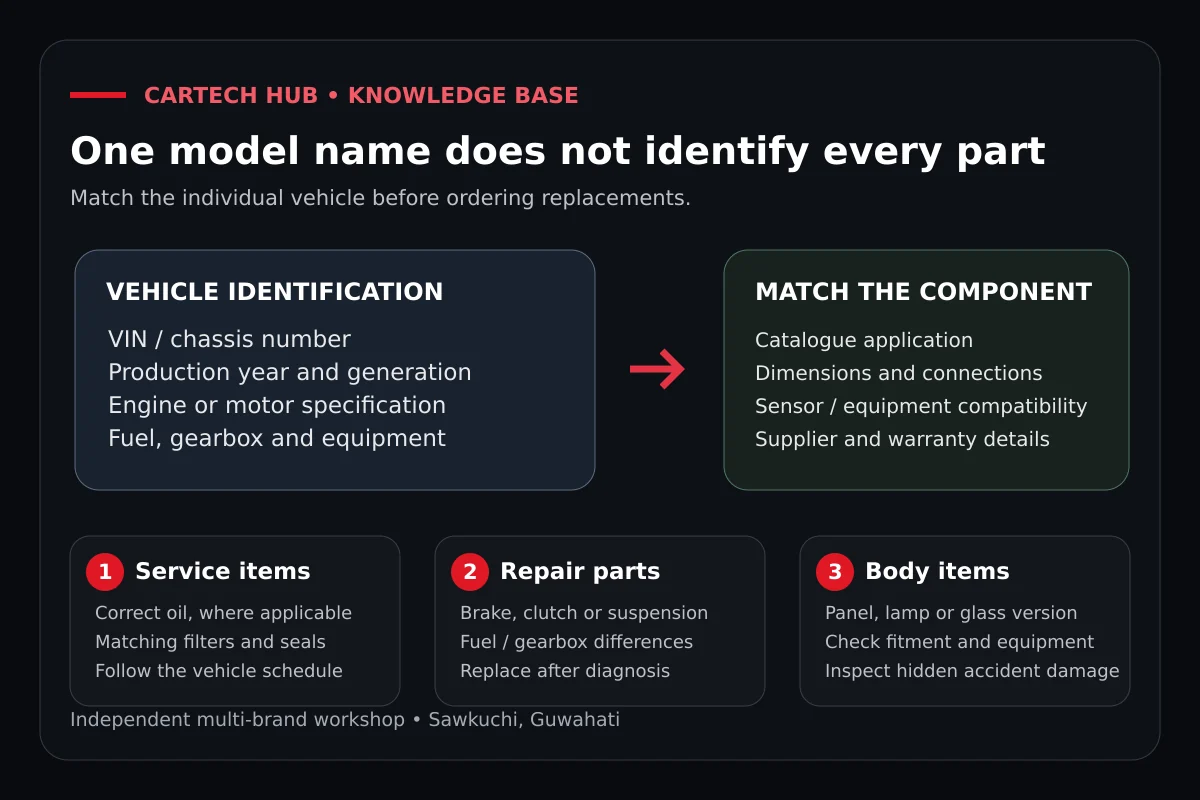
Brake arrangements vary by model, year and variant. A Baleno and an Eeco should not receive a shared parts list simply because both are Maruti Suzuki vehicles. Previous modifications or unusual wheel fitment should be disclosed before work is quoted.
Ask which parts standard is proposed, whether the correct components are available and what the estimate includes. Our parts matching guide explains why vehicle identification matters. A repair quotation should separate diagnosis, components, labour and any follow-up operation rather than hiding the scope behind a “brake package” label.
Be clear about the collection discussion
The handover should explain what caused the concern as far as the findings establish, what was replaced or repaired and how the result was checked. Ask for any applicable bedding or operating instructions for the fitted parts. Those instructions should come from the actual component and vehicle requirements, not a universal sequence copied from another model.
Keep unresolved observations in the job record. If a warning or a changed pedal returns, contact the workshop promptly. Do not regard a recent repair as proof that a new symptom is safe to ignore.
Arrange a safety-focused assessment in Guwahati
CarTech Hub's brake-service information and diagnostic-service page explain the independent multi-brand workshop context. This article is owner education, not remote confirmation that your vehicle is safe to drive or a claim of authorised Maruti Suzuki service-centre status.
Request a brake inspection, call +91 98647 70033 or send the symptom details on WhatsApp. Confirm whether safe recovery is needed before travelling to the Guwahati workshop.
Primary reference information
These references support general owner education. Confirm the guidance for the actual vehicle before approving work.
Quick answers
Is a brake-fluid top-up enough when the level falls?
A change needs investigation. The inspection should consider the actual system condition and any leakage rather than treating repeated top-ups as a repair.
Can brake replacement be quoted from the model name alone?
Only provisionally. Year, variant, fitted system and condition findings are needed to confirm parts and the repair scope.