
In this guide
The Mahindra Verito Vibe requires its own service and body-repair plan even when it is discussed alongside the larger Verito. Its compact rear body makes identification especially important after a collision or when sourcing lamps and trim. For a Guwahati workshop visit, bring the VIN, RC and repair history, plus photographs of any damaged area. CarTech Hub Guwahati is an independent workshop, not an authorised Mahindra service centre. Inspection establishes the work required, parts options and any specialist referral before an estimate is accepted.
Treat the Vibe as a separate legacy model
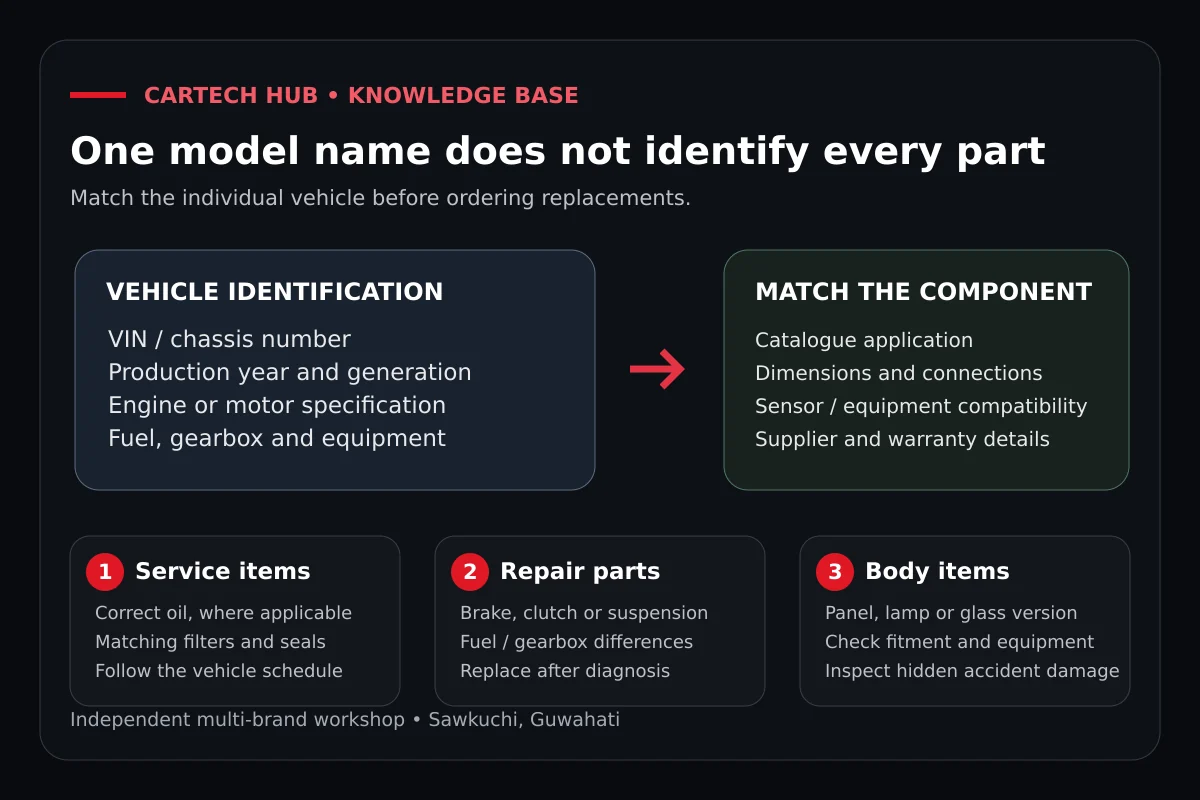
The Vibe is the compact-bodied Verito derivative, rather than the full-length sedan. Its official manual specifies a 1.5-litre dCi diesel engine and five-speed manual gearbox. That provides a starting point for service planning, but VIN, manufacturing year, fuel details, gearbox and trim still need checking. Do not use a general Verito listing as the final parts match. Previous substitutions, accessories and body repairs should be disclosed because a catalogue match alone may not reveal changes made during the car's ownership.
Give diesel filtration and starting checks proper attention
Engine oil and oil-filter replacement should follow the matching maintenance record and manual. Include the engine air filter and applicable diesel fuel filter in the review, using correctly specified parts. A slow or reluctant start raises questions about battery condition, starter supply, glow plugs and their control, and fuel delivery. The Vibe's diesel does not need petrol spark plugs. Uneven running or reduced response calls for evidence-based injector, intake and turbo-system investigation. Ask for findings before agreeing to a fuel-system overhaul or turbo replacement; the symptoms alone do not identify the failed part.
Examine manual gearbox and clutch behaviour
Describe whether a gear is hard to engage with the engine running, whether the clutch slips under load, or whether vibration occurs only during take-up. These observations guide checks of clutch release operation, linkage, mountings and the driveline. The Vibe manual identifies a manual transmission, so an automatic fluid flush is not a suitable default service. Confirm gearbox lubricant requirements and check leaks. Clutch kits, release components and driveshaft-related parts should be identified for the actual vehicle, with dismantling and additional findings authorised before repair costs expand.
Connect compact-car ride checks with safe stopping
Pothole strikes and uneven surfaces justify inspecting wheel rims, tyre damage, struts, dampers, bushes, ball joints and wheel bearings. Explain where and when a sound occurs rather than requesting a particular part immediately. Braking inspection should cover the fitted front discs and rear drums, friction material, wheel cylinders, hoses and parking brake. Steering assessment includes hydraulic assistance, visible leaks and joint condition as appropriate to the car. Correct mechanical issues before alignment. An illuminated safety warning requires investigation of the actual equipment; not every trim has identical systems.
Diagnose cooling, AC and electrical concerns
For changing temperature readings or coolant loss, inspect the radiator, hoses, fan circuit and associated leaks using the correct coolant specification. Stop for an overheating warning and do not open the coolant system while hot. Weak AC airflow invites cabin-filter, blower and duct checks; poor cooling requires suitable leak and pressure testing. Review condensate drainage if moisture or odour appears inside. Battery, alternator, starter and ground checks help separate a no-start complaint from an accessory fault. Also test lamps, horn, wipers and the electrical items fitted to the particular Vibe.
Inspect the compact rear compartment for rain entry
Wet-weather preparation in Guwahati should include tyres, wipers, washers, demisting and visible drainage paths. With the Vibe, inspect rear-compartment seals and lamp-area sealing if the luggage area becomes damp. Rear repairs or poorly seated trim are inspection possibilities, not assumed defects. Photograph any water staining before cleaning. Avoid floodwater of unknown depth; if a water-related engine stall occurs, do not try to restart it. Recovery and an assessment protect the vehicle and preserve useful claim evidence. Follow the correct manual rather than inventing a universal monsoon service interval.
Match short-body panels before committing to a repair date
The Vibe's rear bumper, lamps, boot opening, glass and surrounding panels need compact-body identification. Similar mechanical architecture does not guarantee that a full-size Verito rear part fits. After an impact, examine mounts, closure alignment, seals and the rear floor, as well as visible paint damage. Front repair assessment may involve bumper attachments, lamp supports and the cooling pack. Agree on repair versus replacement, paint scope and parts description. Availability must be confirmed; inventory is not guaranteed. Structural, airbag and specialist calibration work requires verified capability or referral.
Move from insurance notification to checked delivery
Accidental damage may qualify under applicable own-damage cover, while servicing, worn parts and age-related deterioration are generally owner expenses. Third-party-only insurance does not cover your Vibe's own damage. If insured with ICICI Lombard or SBI General, use the insurer's claim channel and obtain a reference. Prepare the policy document, RC, driving licence, completed claim form and photographs, plus any requested additional evidence. CarTech Hub can assist with the workshop estimate and survey coordination; approval of cover and repair scope belongs to the insurer. Leave the Vibe's insured repair and dismantling pending the required inspection and insurer approval, unless the insurer specifically authorises an exception.
Authorise the approved scope and record any separate customer-paid work. Supplementary damage needs further assessment and approval where required. Cashless repair depends on policy conditions, survey, insurer approval and verified workshop network status; these names do not imply a partnership. Confirm deductibles, depreciation and non-payable items, with add-on limits checked. Quality checks should include rear-compartment sealing, closure operation, lamps, braking and agreed mechanical tests before delivery. Book Vibe service, open claim assistance, call 9864770033, or share details through WhatsApp.
Quick answers
Why is the Vibe listed separately from the Verito?
The Vibe has a compact rear body. Service identification and body parts enquiries should recognise that body style rather than treating it as the full-length sedan.
Should I buy spark plugs for a Verito Vibe service?
The official Vibe manual describes a diesel engine. Its starting assessment may involve the glow system, battery and fuel delivery rather than petrol spark plugs.
Can luggage-area dampness be repaired by repainting the rear panel?
Paint alone may not address a leak. Inspect seals, lamp mounting areas, closure fit and previous repairs to establish how water enters before authorising the remedy.
Can a compact rear-body part be promised before inspection?
Only after fitment, condition and availability are checked. Share the VIN and damage photographs; unusual or legacy-model parts may need a sourcing enquiry before a delivery estimate is reliable.