
In this guide
An early Mahindra KUV100 can remain useful for everyday Guwahati journeys when its maintenance history is understood. A petrol example used for short school runs needs different investigation from a diesel that regularly travels outside the city. Before booking work, collect the registration details, previous invoices and a description of what has changed. CarTech Hub Guwahati is an independent workshop, not an authorised Mahindra service centre. An inspection and written estimate establish which mechanical, body or claim-assistance work is appropriate.
Identify the original KUV100 before choosing parts
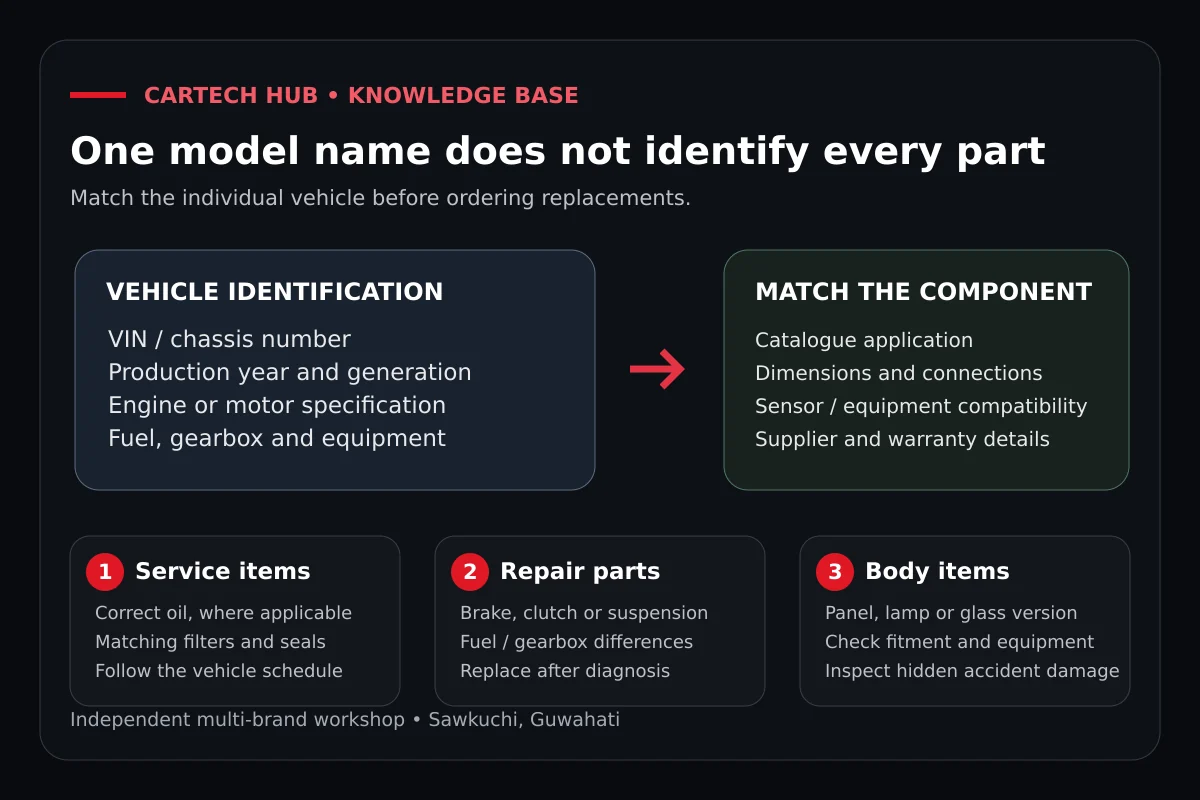
This guide covers the earlier KUV100, a legacy model, rather than automatically treating it as a KUV100 NXT. Mahindra's original manual describes the 1.2-litre mFalcon G80 petrol and D75 turbo-diesel, with a five-speed manual transaxle. Equipment also differs across versions. Record the VIN, manufacturing year, fuel, engine and gearbox before ordering. Seat configuration, lamp equipment and previous modifications can matter too. A badge or photograph alone cannot establish whether a filter, bumper bracket or electrical connector fits.
Build the engine service around the fuel type
Engine oil and the oil filter should follow the specification and schedule in the manual applicable to that vehicle. Ask whether the service history supports replacement now, and inspect the air filter, intake ducting and applicable fuel filter. On the petrol G80, an uneven idle raises questions about spark plugs, ignition coils, wiring and fuel delivery. On the D75 diesel, difficult starting calls for battery, glow-system and fuel-system checks. Injector testing and turbo or boost-hose assessment should follow diagnostic evidence; hesitation is not proof that an expensive assembly needs replacement.
Check the dashboard gearshift and clutch operation
The early KUV100's manual gearbox requires a manual-transmission assessment, not an automatic service package. Describe whether difficulty appears while selecting first gear, engaging reverse or accelerating under load. A technician can inspect the clutch release system, shift linkage, mountings, driveshaft boots and gearbox leaks before proposing repair. A change in clutch bite or vibration asks for measurement and a controlled test, rather than a clutch replacement by assumption. Use the correct gearbox fluid specification for the identified car; do not combine engine and transmission fluid recommendations.
Inspect brakes, steering and the compact suspension
Discuss braking pull, scraping, pedal feel and parking-brake performance before the vehicle is lifted. The original manual identifies front discs and rear drums, so rear braking inspection should include the appropriate shoes, wheel cylinders and adjustment. Pothole impacts justify checks of tyres, rims, struts, springs, bushes, steering joints and wheel bearings. Steering assistance and safety equipment must be checked against the actual variant. If there is bearing noise or an ABS warning where fitted, diagnosis should establish its source before a hub, sensor or steering assembly is ordered.
Keep cooling, AC and electrical checks connected
For slow traffic and humid days, record whether cooling changes when the car stops or starts moving. Check coolant condition, leaks, radiator airflow, fan operation and hoses using the correct vehicle specification. An overheating warning needs prompt attention; never open a hot coolant system. Weak cabin airflow invites inspection of the cabin filter, blower and ducts, while poor AC cooling needs leak and pressure diagnosis. Battery testing, alternator output, starter performance, earth connections, lamps and wipers help distinguish a starting complaint from a wider electrical issue.
Prepare for Guwahati rain without guessing intervals
Before the wet season, review tyre tread and pressures, wiper clearing, washer operation, demisting and visible drain openings. Damp carpets should prompt questions about door seals, windscreen sealing or blocked drains. After an impact in a hidden pothole, inspect the wheel and underbody rather than relying on appearance. Avoid floodwater of uncertain depth. If the engine stalls in water, do not restart it: arrange recovery and inspection, preserving photographs for the insurer. There is no single shortened service interval suitable for every early KUV100; use its manual and operating history.
Match body repair to hidden damage and parts availability
A low-speed front impact may involve the bumper skin, grille, headlamp supports, bonnet latch or cooling components. Rear damage may extend beyond the bumper to lamps, brackets, boot-area seals and floor sections. An estimate should distinguish cosmetic repair from necessary replacement and document concealed damage once inspection is authorised. Genuine or other suitable parts options must be identified clearly, with fitment and availability checked first; stock is not guaranteed. Structural damage, deployed airbags and specialist calibration needs require confirmed capability or referral before work is accepted.
Follow an insurance workflow separate from servicing
Routine oil changes, worn clutch parts and age-related faults are generally maintenance expenses. Accidental damage to your own KUV100 requires applicable own-damage cover; third-party-only insurance does not provide that cover. Whether the policy is from HDFC ERGO or ICICI Lombard, notify the insurer, obtain a claim reference and prepare the policy document, RC, driver's licence, claim form and incident photographs. Additional documents may be requested. The workshop prepares an estimate for survey and assessment; the insurer decides coverage and approval. Leave accident-related dismantling and repairs until the insurer's required inspection and approval are complete, unless the insurer specifically authorises an earlier step.
Agree to the approved repair scope and separately authorise any customer-paid work. Cashless handling depends on the policy, insurer approval, survey and the workshop's current network status; no insurer relationship is implied here. Ask about deductibles, depreciation and non-payable items, including conditions on any add-on. After repair, review braking, lamp operation, panel fit, leaks and the agreed quality checks before delivery. Use claim assistance for the intake process or book KUV100 service. Call 9864770033 or WhatsApp CarTech Hub with the vehicle details.
Quick answers
Is this guide for the first KUV100 or the NXT?
It focuses on the earlier KUV100. Share the VIN and year so the workshop can identify the correct manual, trim and parts rather than treating every KUV100 as a NXT.
Does every early KUV100 need the same ignition parts?
No. The petrol engine uses spark ignition, while the diesel uses a glow system for relevant starting checks. Order parts only after the fuel type and engine are confirmed.
Can a difficult dashboard gearshift prove the clutch is worn out?
No. Linkage, clutch release operation, mountings and gearbox condition can also affect selection. Inspection should identify the cause before a replacement is authorised.
Can a service visit and an accident claim be handled together?
They can be planned during one visit, but maintenance and incident-related repairs need separate estimates and authorisation. The insurer decides which damage is covered.