In this guide
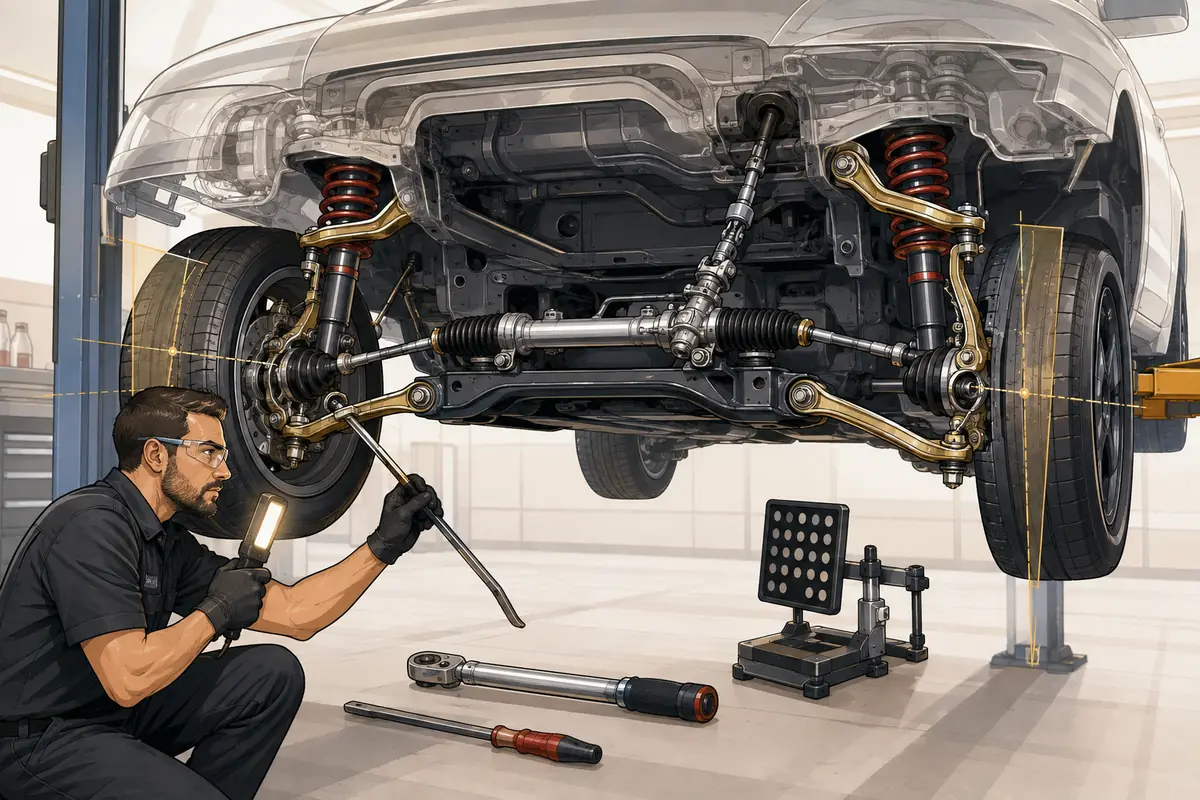
If suspension work has been carried out, a customer may be told that wheel alignment is the next step. That recommendation deserves an explanation: what was repaired, what measurements are relevant and what the final checks show.
A steering concern after repair should not become a contest between the owner’s impression and a printed receipt. A useful handover connects the inspection, the repair and the remaining symptoms.
Start with the work that was done
Read the invoice and identify the suspension or steering components involved. Ask whether their replacement or adjustment affects the alignment checks required for your model. Not every service operation has an identical follow-up procedure.
Tell the technician whether the car was pulling, the steering wheel was off-centre or the tyres were wearing unevenly before the repair. Record what changed after the work. This history helps distinguish the original complaint from a new concern.
Alignment and balancing answer different questions
Michelin India explains alignment as adjustment of wheel angles according to vehicle specifications, while balancing concerns the distribution of mass in the tyre-and-wheel assembly. They should not be sold as interchangeable solutions.
A vibration, a directional pull and unusual tyre wear can require different checks. Those symptoms alone do not prove which operation is needed. Ask for an inspection-based recommendation rather than authorising both services because the names are often spoken together.
Ask to understand the report
Where a measurement report is provided, request an explanation of the initial and final readings. Which vehicle specifications were used? What could be adjusted, and what remains outside the intended result? You do not need to become an alignment technician to ask these questions.
Some concerns may need further mechanical assessment rather than another adjustment. Ask whether a remaining issue has been identified, needs investigation or cannot yet be reproduced. A report should not be treated as a substitute for explaining those limits.
Do not use a dangerous road test to prove a point
Never release the steering wheel in traffic to demonstrate that the car pulls. Describe the concern and let a qualified professional decide how it can be assessed safely.
If steering feels unpredictable, a wheel appears damaged or the vehicle feels unstable, stop in a safe place and seek assistance. Do not drive a damaged car to the workshop solely to avoid arranging recovery.
Agree what the next step covers
Before further work, separate the cost of assessment from the cost of any proposed repair. Ask whether a repeat alignment is being recommended because the original repair has changed, because a measurement needs checking or because another fault has been found.
Keep the work order and report together. If the concern returns, that record is more informative than the phrase “alignment already done.”
CarTech Hub – Multi-Brand Car Workshop in Guwahati provides steering service information, vehicle-specific maintenance guidance and accident assessment information. Customers in Assam can request an assessment and confirm the available inspection scope before bringing the vehicle.
Further reading: Michelin India on alignment and balancing.