In this guide
A recovery call after an accident is not an ordinary workshop booking. The operator needs enough information to decide whether the location is accessible and what equipment may be required. A vague request such as “send someone near me” can leave important questions unanswered.
Personal safety comes first. If anyone is injured, there is fire or the scene presents immediate danger, contact the appropriate emergency services. Do not enter traffic or approach a hazardous vehicle to collect photographs for a towing quotation.
Give a location that another person can find
Share a map pin where possible, followed by a road name, direction of travel and a visible landmark. Explain whether the car is on the carriageway, a narrow lane, a slope or private premises. Mention any barrier, low entrance or other access restriction you can describe safely.
Tell the operator where you want the vehicle taken. The pickup point and destination both affect planning; a workshop name alone may not identify the entrance or receiving arrangements.
Describe the vehicle without experimenting
Provide the make, model and whether it is manual, automatic, hybrid or electric. Say whether the wheels appear damaged, whether the car rolls normally and whether the steering or parking brake is unavailable. Report fluid leakage, water exposure or other visible hazards without touching them.
Do not force the transmission selector, drag a damaged wheel or improvise a towing attachment. For a hybrid or electric vehicle, make the powertrain type clear and do not approach exposed high-voltage components.
Why the owner’s manual matters
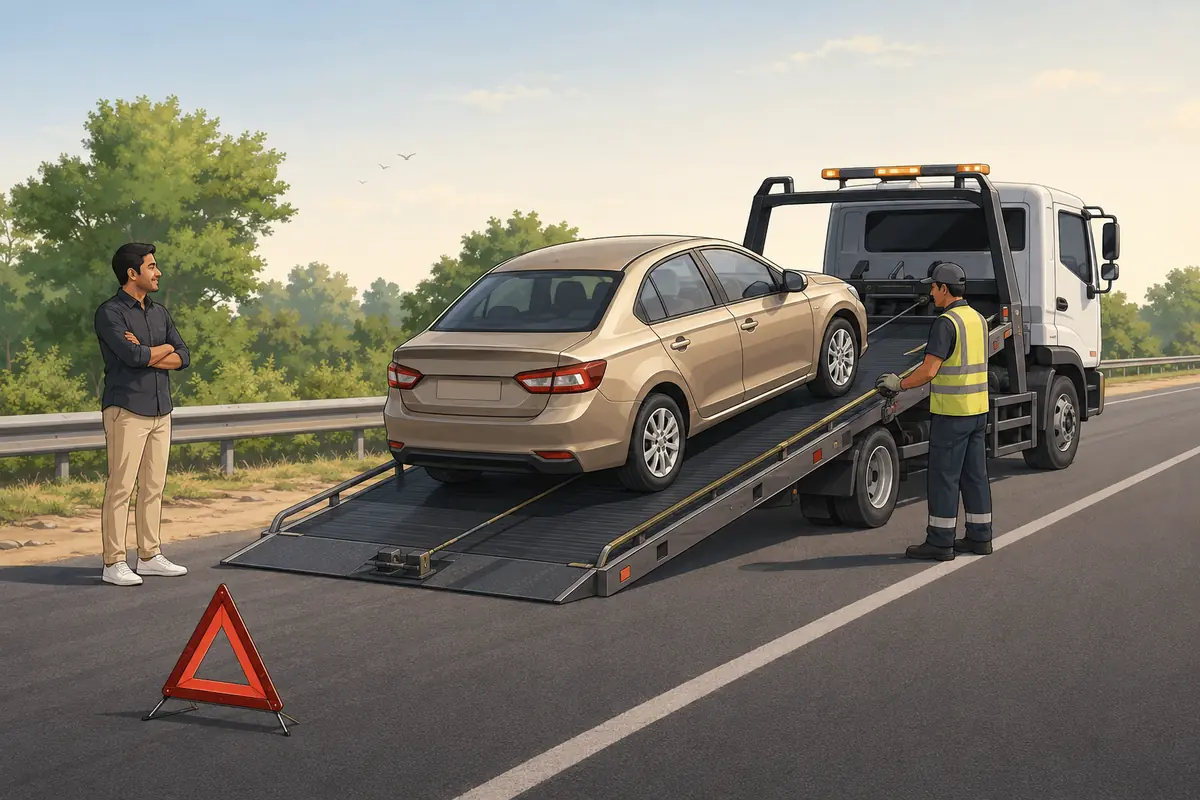
Recovery restrictions are model-specific. For example, the Hyundai Exter manual sets out wheel-lift, dolly and flatbed guidance and warns against certain wheels-on-ground towing arrangements. This demonstrates why another car’s towing method should not simply be copied.
The recovery professional should select a method compatible with the vehicle, damage and access. A flatbed may be appropriate in many situations, but an article cannot determine equipment suitability from a model name alone.
Agree the recovery scope
Ask for the quoted destination, charges, estimated availability and any likely extra handling requirement. Check whether the insurer or roadside assistance provider requires its own authorization before you arrange an independent recovery.
Keep the operator’s contact details and recovery receipt. If safe, retain photographs showing the car’s condition before loading and after delivery. Do not obstruct emergency work to obtain these records.
Separate towing from claim approval
Recovery assistance and insurance settlement are different decisions. Cashless authorization, claim admissibility and final approval depend on the customer’s policy terms, insurer approval, survey findings and applicable network/cashless arrangements.
CarTech Hub – Multi-Brand Car Workshop in Guwahati publishes accident repair and recovery information. Use the workshop contact request for non-emergency coordination and confirm current availability directly; do not assume an online form dispatches a truck immediately. Read waterlogging guidance if flood exposure is involved, and the claim assistance overview when planning an insurance repair.
Vehicle-specific reference: Hyundai Exter owner’s manual.